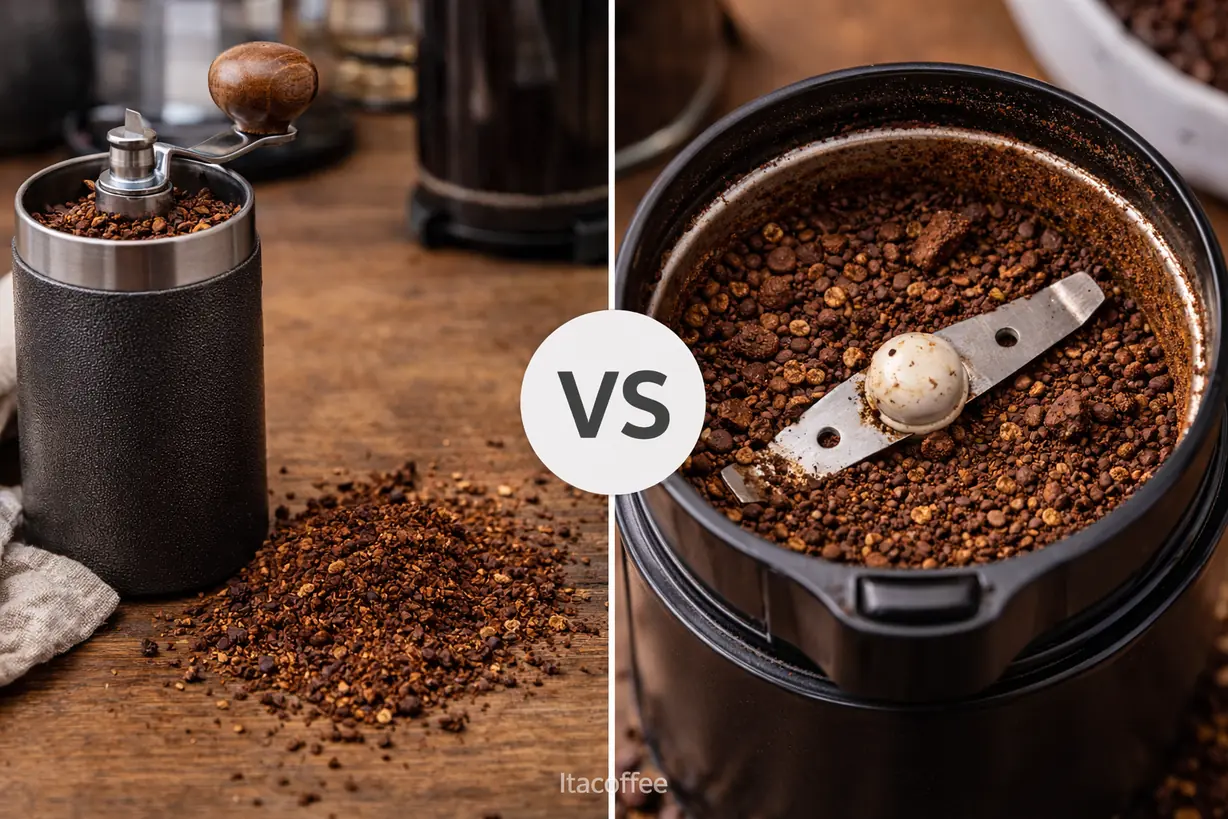
The decision to grind coffee immediately before brewing is not a matter of preference; it is a fundamental requirement for preserving the chemical integrity of the bean. In coffee brewing, the roasted bean acts as a protective vault for volatile aromatics, organic acids, and delicate lipids. Once that vault is broken, a rapid and irreversible process of degradation begins. While pre-ground coffee offers convenience, it inherently guarantees a compromise in physical structure and flavor complexity.
Understanding why freshly ground coffee matters requires examining the specific chemical reactions that occur when coffee is exposed to oxygen and moisture, and how these changes directly impact the mechanics of extraction.
In This Guide
The Chemistry of Staling: Oxidation and Volatile Loss
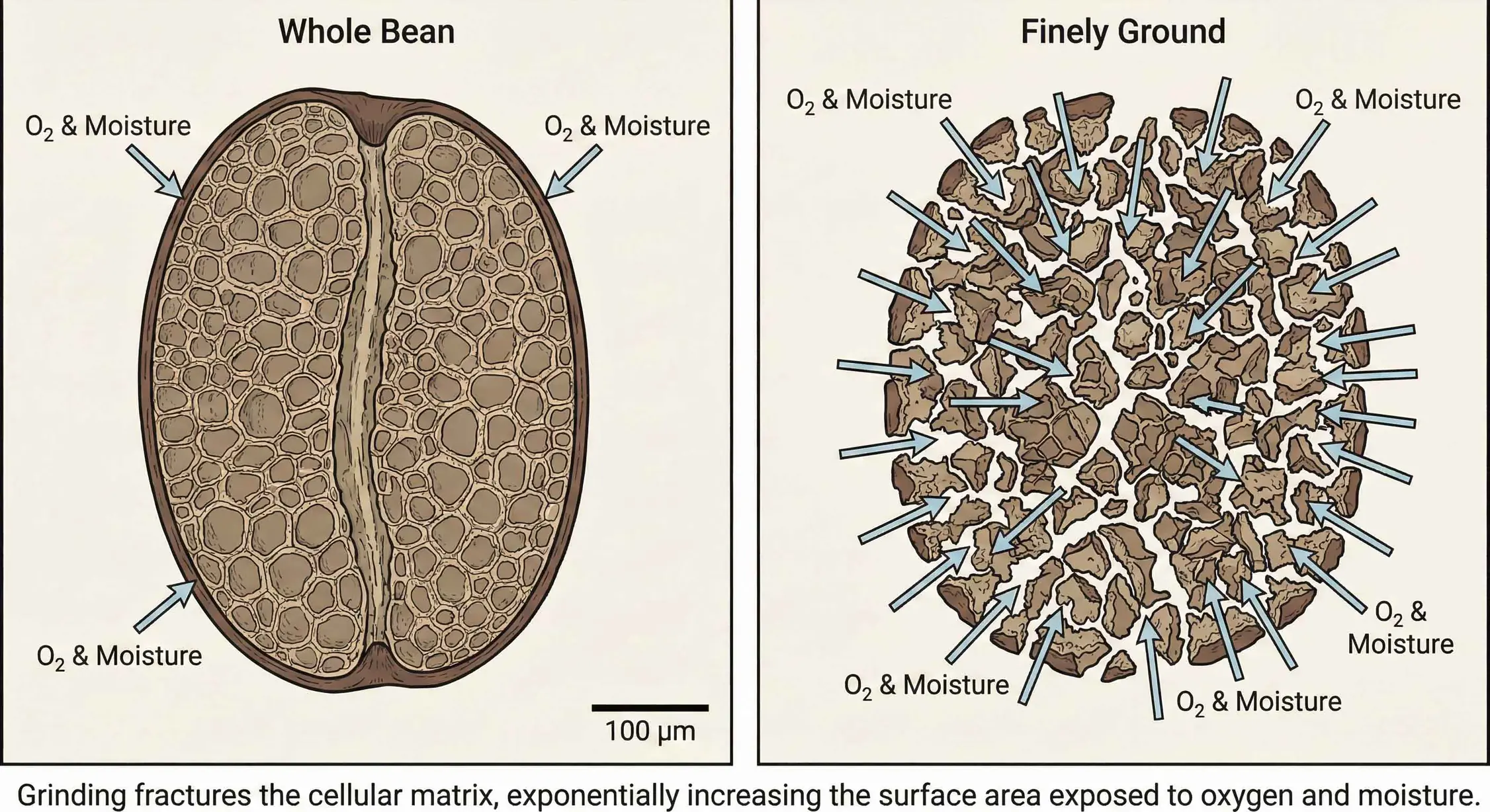
Coffee beans contain over a thousand distinct chemical compounds responsible for flavor, aroma, and body. When a bean is pulverized into grounds, it immediately undergoes two destructive processes:
- 1. Oxidation. The lipids (oils) and delicate cellular structures within the coffee are highly reactive to oxygen. Oxidation degrades these oils, turning them rancid and replacing vibrant, complex acidity with flat, woody, or stale notes.
- 2. Volatile Compound Evaporation. The aromatics that define a coffee’s origin characteristics—floral, fruity, and sweet notes—are highly volatile. They are held within the bean under pressure from carbon dioxide (CO2). Grinding releases this pressure, causing the rapid evaporation of these lightweight molecules. Within just 15 minutes of grinding, coffee can lose up to 60% of its volatile organic compounds.
Surface Area Dynamics: The Catalyst for Degradation
The rate at which oxidation and evaporation occur is directly proportional to the surface area exposed to the environment. A whole coffee bean has a relatively small, protective outer surface. Grinding fractures the bean into hundreds or thousands of microscopic particles.
This exponential increase in exposed cellular structure is what allows water to dissolve coffee compounds during brewing. However, it also allows oxygen to penetrate the coffee just as efficiently. By leaving ground coffee exposed to the air for hours or days, the compounds meant to be extracted by water are instead lost to the atmosphere. For a deeper understanding of how particle division affects solubility, refer to the physics of surface area and extraction.
The Impact on Extraction Mechanics
Beyond flavor loss, grinding ahead of time alters the physical behavior of the coffee during the brewing process.
1. Loss of Carbon Dioxide (CO2)
During roasting, CO2 becomes trapped within the bean’s cellular matrix. When freshly ground coffee meets hot water, this gas escapes rapidly, creating the “bloom.” This outgassing provides necessary resistance to the brew water, slowing its descent and allowing for an even, controlled extraction.
Pre-ground coffee has already lost its CO2. Consequently, water flows through the coffee bed with minimal resistance, often leading to rapid flow rates, channeling, and ultimately, poor extraction yields. This is a common culprit when trying to diagnose under vs over extraction defects.
2. Inability to Dial In
Precision brewing requires constant micro-adjustments. As beans age, their solubility changes. A barista must continually adjust the grind size to maintain a consistent flow rate and optimal body, texture, and mouthfeel. Pre-ground coffee locks you into a single, fixed particle size. If the resulting brew is too fast or too slow, you have forfeited the primary mechanical tool needed to correct the error.
Comparing Whole Bean vs. Pre-Ground: A Structural Breakdown
| Variable | Freshly Ground (Immediate) | Pre-Ground (Aged > 24 hrs) |
|---|---|---|
| Volatile Aromatics | Intact; released into the brew water. | Largely evaporated into the atmosphere. |
| CO2 Content | High; facilitates blooming and flow resistance. | Depleted; causes rapid drawdowns and channeling. |
| Dialing In | Fully adjustable to control extraction rate. | Fixed; cannot be adjusted to fix brew defects. |
Conclusion
Brewing pre-ground coffee is mathematically equivalent to brewing a compromised solvent. The molecular structures required to yield sweetness, complex acidity, and a lingering finish have already degraded before the water is poured. To achieve absolute control over your extraction yield and cup clarity, the coffee must remain intact until the exact moment of brewing.
Invest in a precision burr grinder. Control the surface area, preserve the volatile compounds, and let the chemistry work in your favor.
— ITA Coffee | Brewing Guides for Curious, Thoughtful Coffee Makers
Editorial note: This article was developed with AI-assisted drafting and human review to ensure clarity, accuracy, and an educational, non-commercial tone.