In the pursuit of precise coffee brewing, water temperature and brew ratio establish the framework—but grind size controls the velocity of the extraction. It determines how quickly water dissolves organic acids, sugars, lipids, and bitter plant fibers from the roasted coffee matrix.
Understanding coffee grind size extraction dynamics is the difference between blindly following a recipe and deliberately calibrating flavor. Without a clear grasp of how particle size alters physical behavior, diagnosing a flawed brew relies entirely on guesswork.
Two primary physical mechanisms govern extraction through grind size:
- Surface area exposure (which dictates the dissolution rate).
- Water flow resistance (which dictates contact time in percolation).
Master these variables, and your brewing approach shifts from intuition to controlled physics.
In This Guide
The Physics of Surface Area and Extraction Rate
The core principle governing extraction is geometry. When a coffee bean is fractured into smaller particles, its total exposed surface area increases exponentially, even though the total mass remains identical. Water acts as a solvent: a greater surface area provides the solvent with faster access to soluble compounds.
A finer grind exposes high surface area and shortens the diffusion distance. Water quickly penetrates the shallow depth of each particle, rapidly accelerating the extraction rate.
A coarser grind exposes lower total surface area and increases the diffusion distance. Water must travel deeper into the center of each particle to dissolve compounds, significantly slowing the extraction rate.
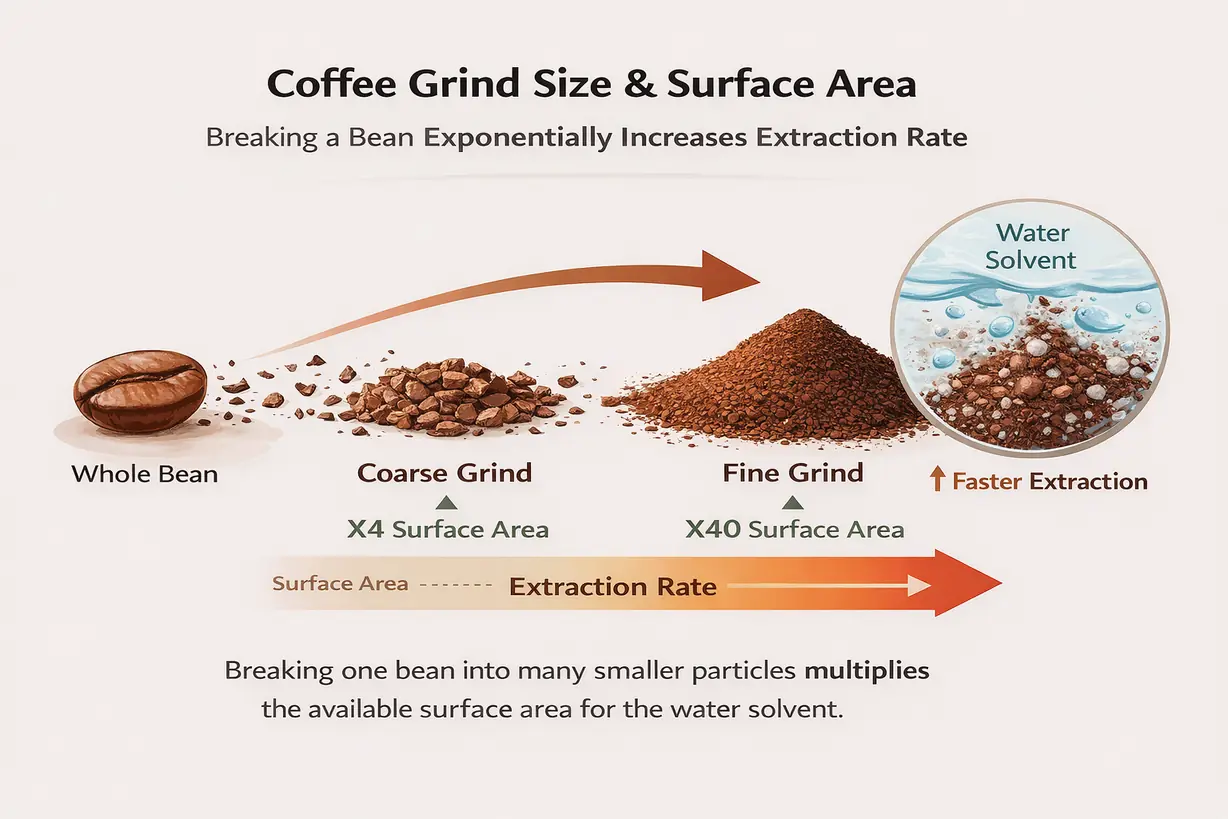
This physical reality dictates brewing methods: espresso utilizes intense pressure and a ≈30-second contact time, necessitating an extremely fine grind. Conversely, cold brew relies on a 12 to 16-hour steeping phase, requiring a coarse grind to prevent severe over-extraction.
Flow Resistance and Contact Time
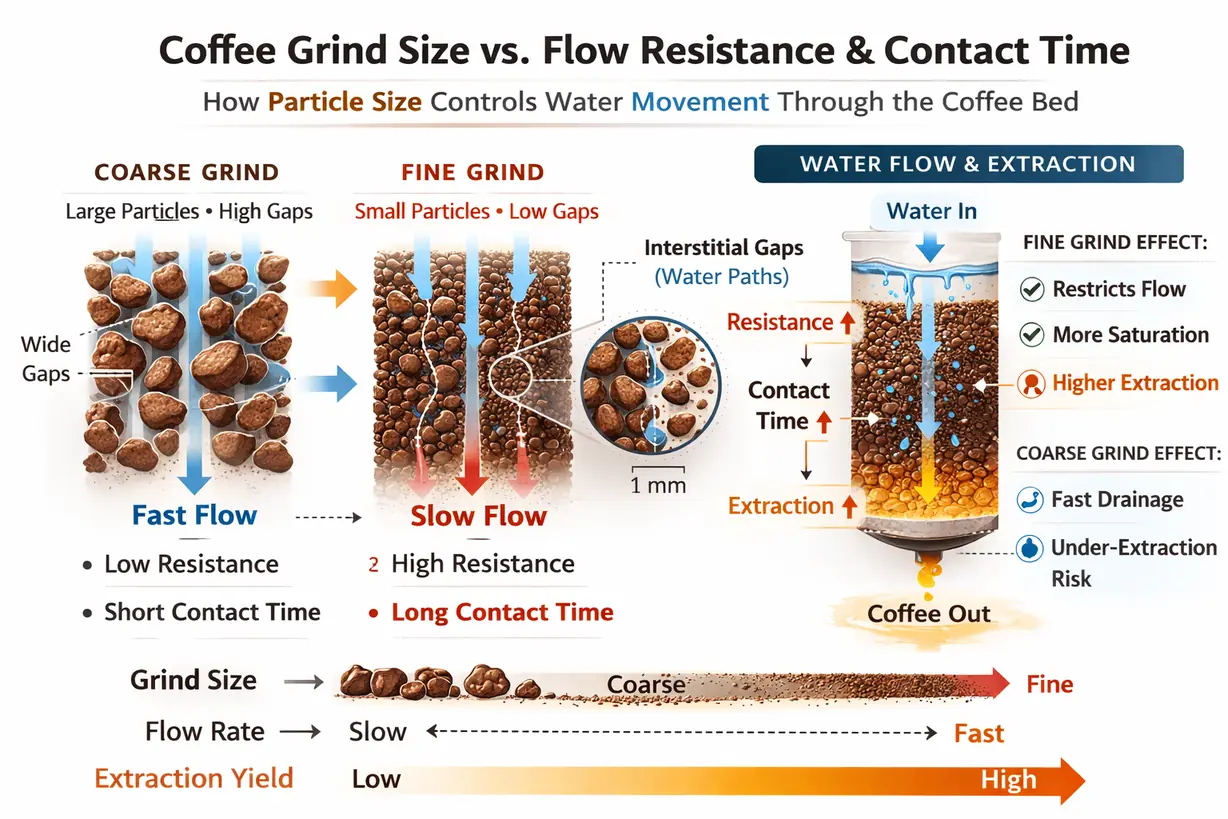
In percolation brewing (such as pour-over or espresso), grind size performs a secondary structural function: it physically reshapes the coffee bed and dictates fluid dynamics.
Fine particles pack densely, creating microscopic interstitial gaps between the grounds. These narrow fluid pathways increase physical resistance, thereby slowing the water’s descent and prolonging contact time. Coarse particles leave wider channels, allowing gravity to pull water through the bed rapidly.
Further Reading: For a deeper breakdown of how physical forces differ across brewing structures, see Immersion vs Percolation: Coffee Extraction Physics.
Fresh coffee introduces a disruptive variable: carbon dioxide (CO₂). When hot water contacts the grounds, trapped gas rapidly escapes. Fine grinds release gas aggressively, which can obstruct water flow, prevent even saturation, and cause channeling.
Further Reading: To understand the mechanics of degassing during a pour-over, read What Is Coffee Blooming? Why Fresh Coffee Bubbles and Why It Matters.
Diagnosing Extraction: Under vs. Over
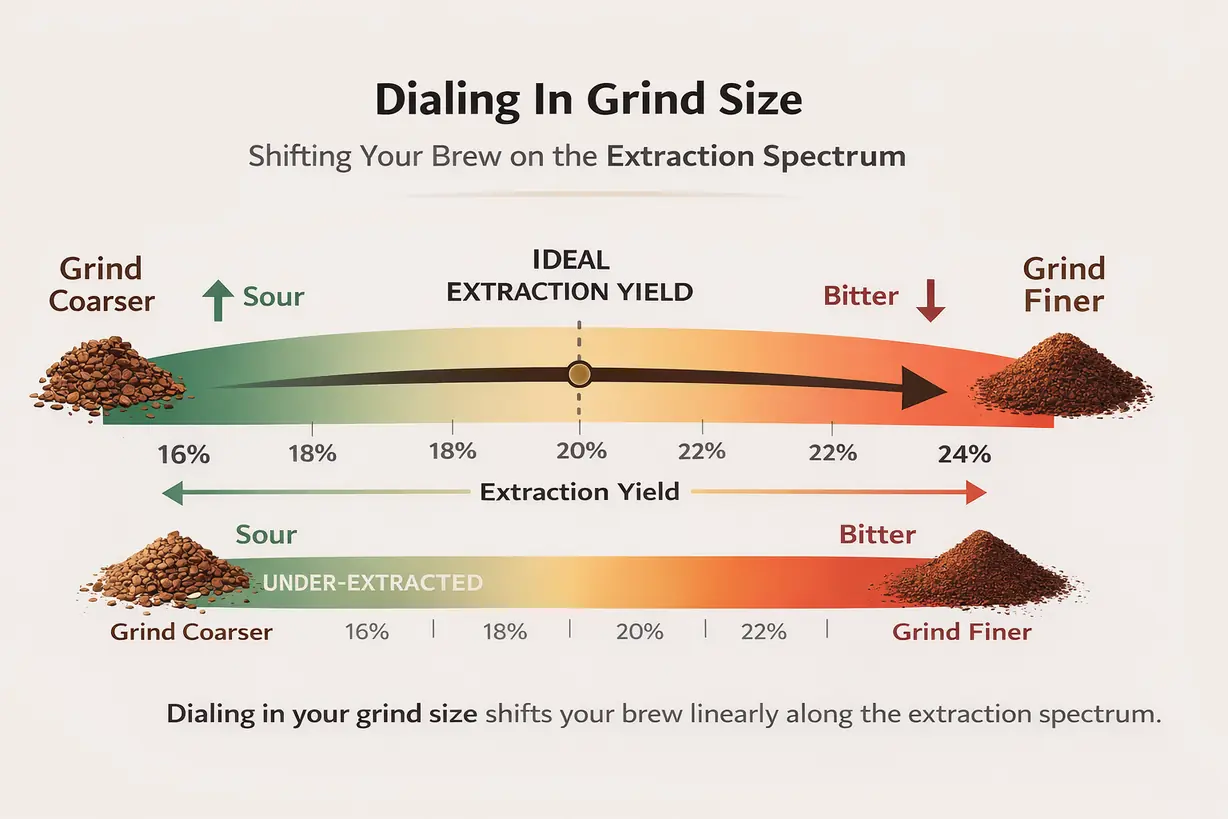
Adjusting grind size is your most precise mechanical lever for correcting flavor imbalance. To utilize it, you must understand the chemical sequence of extraction: fruit acids and salts extract first, followed by complex sugars, and finally heavier, bitter plant fibers.
For industry reference standards on optimal yield ranges, refer to the Specialty Coffee Association Brewing Control Chart.
Under-Extraction (Grind is Too Coarse)
- Mechanism: Low surface area combined with rapid flow prevents water from reaching the slower-dissolving sugars. Only the fast-extracting acids make it into the cup.
- Taste: Intensely sour, sharp, lacking sweetness or structural balance.
- Texture: Thin body, watery mouthfeel, with a highly fleeting finish.
Over-Extraction (Grind is Too Fine)
- Mechanism: High surface area and prolonged contact time force the water to dissolve the late-stage, undesirable plant fibers and tannins.
- Taste: Harsh bitterness that masks origin characteristics, muted acidity.
- Texture: Dry, astringent, chalky sensation on the tongue.
Note: Do not confuse high extraction with high concentration. A bitter, over-extracted coffee can still have a thin body if the water ratio is too high. For a clear distinction, read Is More Coffee Always Stronger? Strength vs Extraction Explained.
The Critical Role of Grind Uniformity
Grind size is only a viable control variable if your grinder produces a uniform particle distribution.
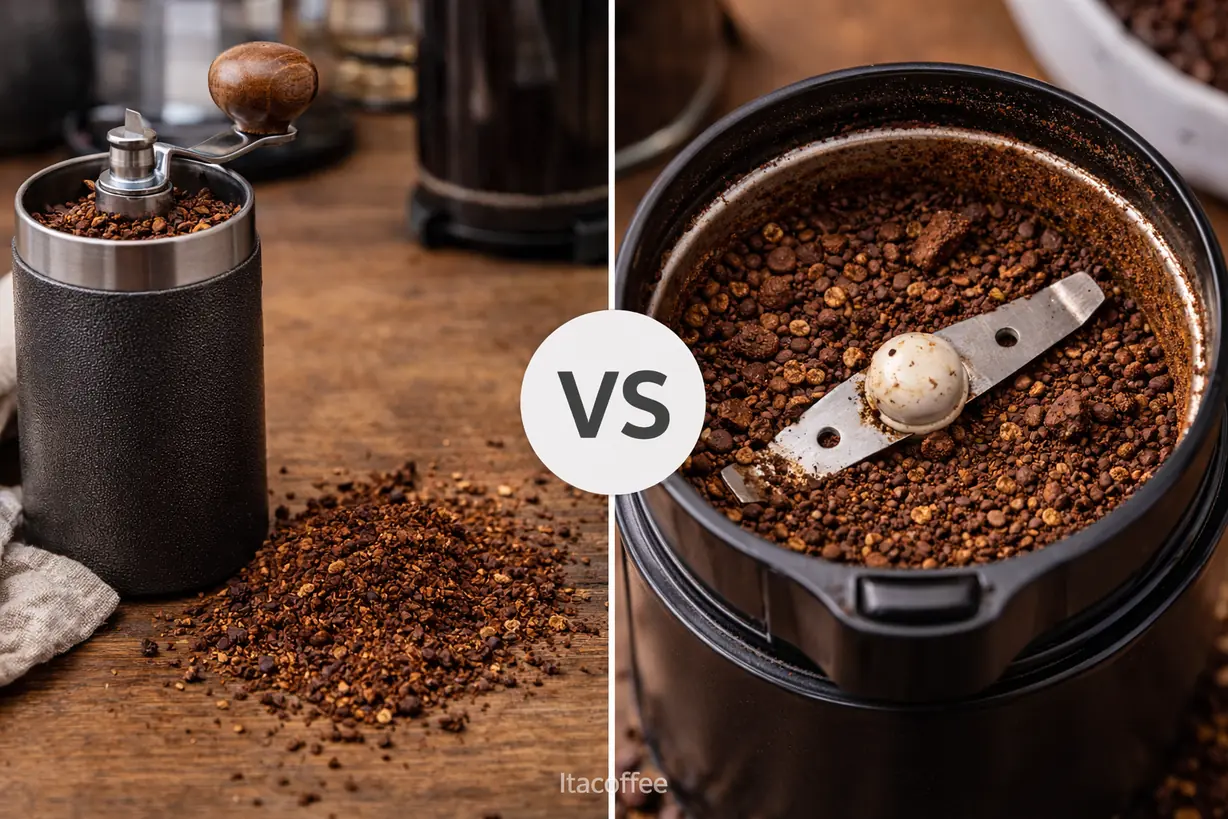
If inferior burrs or blades produce a wide spectrum of fine dust (“fines”) alongside large fragments (“boulders”), precise extraction becomes impossible. Within the exact same brew:
- The fines will over-extract, injecting harsh bitterness.
- The boulders will under-extract, injecting hollow sourness.
The resulting cup will be confusingly astringent and highly acidic simultaneously.
Further Reading: For a mechanical explanation of how grinder design solves this issue, see Burr vs Blade Coffee Grinders: What’s the Real Difference?
How to Adjust Grind Size Intelligently
The cardinal rule of calibration: Change only one variable at a time. Lock in your brew ratio, water temperature, and pour technique. Only adjust the grind setting.
| Taste Result | Diagnosis | Mechanical Adjustment |
|---|---|---|
| Sour, sharp, fast drawdown | Under-extracted | Grind Finer |
| Bitter, dry finish, slow drawdown | Over-extracted | Grind Coarser |
Frequently Asked Questions
Does ideal grind size change with roast level?
Yes. The roasting process degrades the cellulose structure of the bean. Dark roasts are highly brittle and highly soluble, making them susceptible to rapid over-extraction; they typically require a slightly coarser grind. Light roasts are dense and less soluble, often requiring a finer grind to force adequate extraction.
Reference: Dark Roast vs Light Roast: What Roasting Really Changes.
Why must I adjust grind size as beans age?
Fresh beans contain significant volumes of CO₂. As they degas over the weeks following the roast date (a process documented extensively in coffee degassing kinetics), physical resistance within the coffee bed decreases. To maintain a consistent brew time and extraction rate as beans age, you must often adjust your grinder slightly finer to compensate for the lost gas resistance.
Final Thought from ITA Coffee
Grind size is not a static recipe setting. It is a dynamic control dial used to manage extraction velocity.
By understanding how particle size directly manipulates surface area, flow resistance, and solubility, you can evaluate any cup of coffee logically and apply a precise mechanical correction.
Measure carefully. Adjust deliberately. Let your palate confirm the physics.
— ITA Coffee | Brewing Guides for Curious, Thoughtful Coffee Makers
Editorial note: This article was developed with AI-assisted drafting and human review to ensure clarity, accuracy, and an educational, non-commercial tone.