At ITA Coffee, reviews are built on clarity, independence, and real-world use.
The Reviews section exists to help readers choose coffee tools based on how they influence extraction, control, and repeatability — not branding or marketing claims.
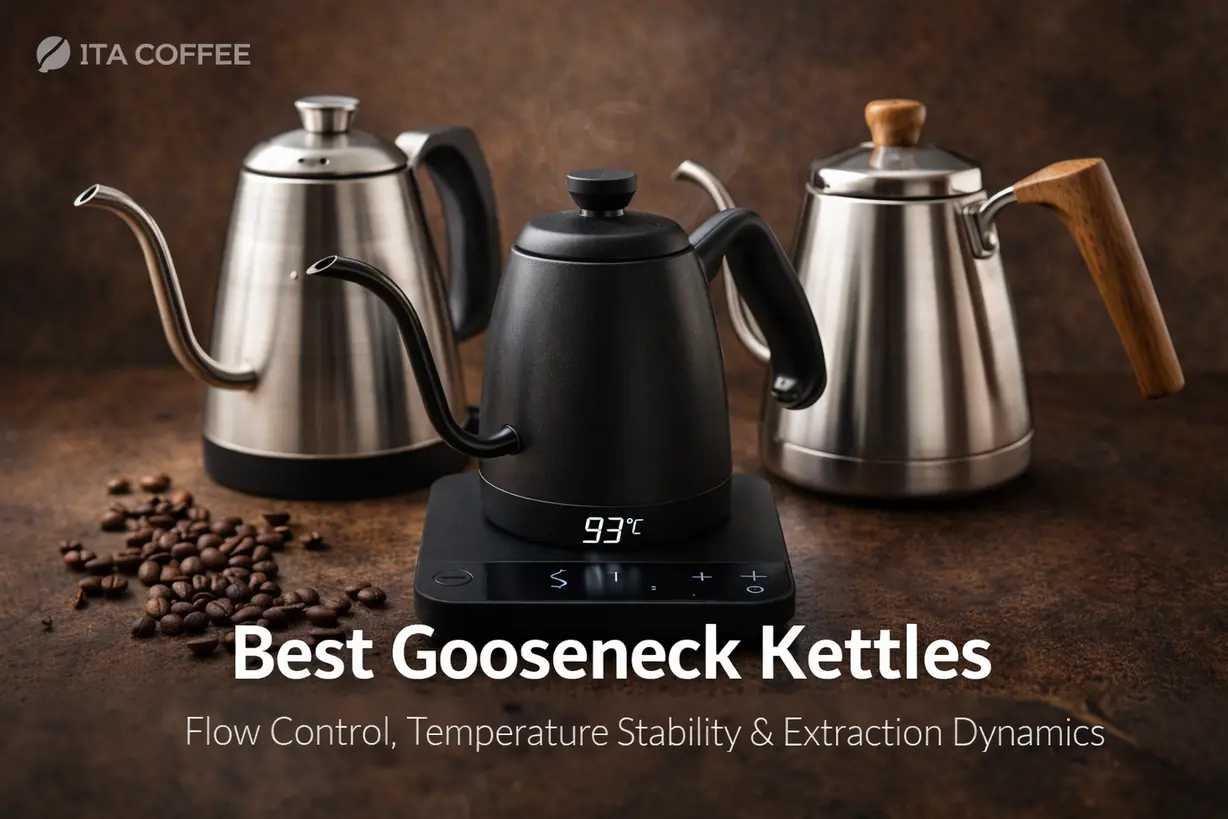
This guide analyzes the best gooseneck kettles by focusing on one critical function: how water is delivered to coffee grounds, and how that affects extraction quality.
In This Guide
Why Gooseneck Kettles Matter (Beyond “Pouring Water”)
A gooseneck kettle is not simply a container for hot water. It is a flow control device that directly influences extraction dynamics.
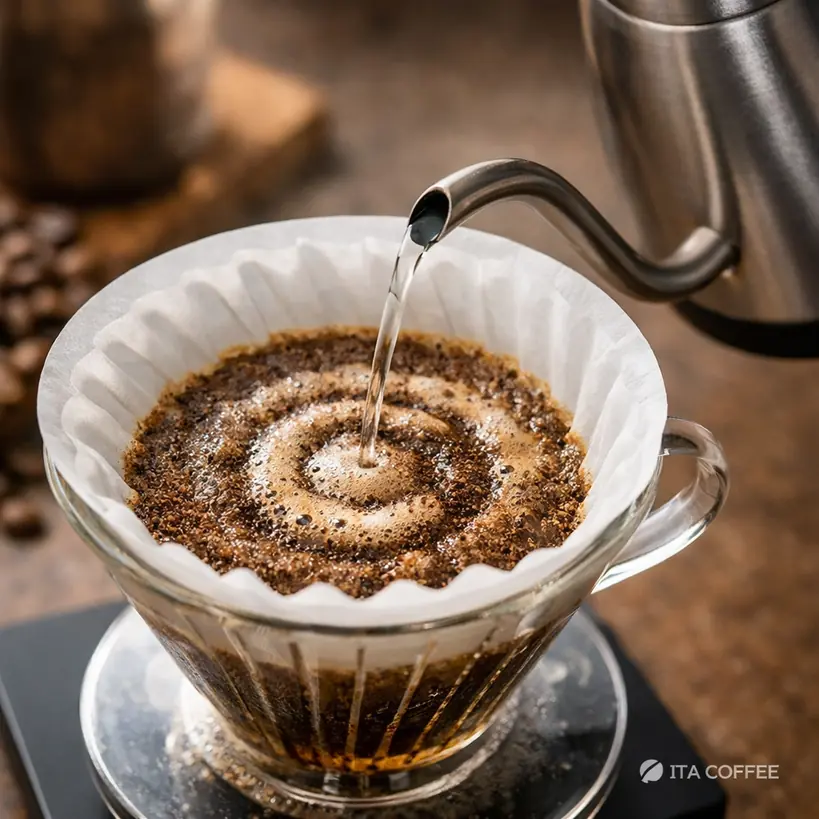
In pour over brewing, extraction depends on how evenly water interacts with coffee grounds. This involves:
- Flow rate (g/s)
- Pour pattern (distribution across the bed)
- Agitation (movement of particles)
These variables determine whether extraction is uniform or uneven. As explained in What Is Percolation Brewing?, water flows through the coffee bed, dissolving compounds progressively. Poor control leads to channeling (uneven flow paths), which reduces extraction quality.
Core Principle: Flow Rate and Extraction Control
What Is Flow Rate?
Flow rate refers to how quickly water exits the kettle, typically measured in grams per second.
A controlled flow rate allows you to:
- Maintain stable saturation during bloom
- Avoid disturbing the coffee bed
- Control extraction time precisely
Without control, water either floods or bypasses parts of the bed, leading to imbalance — a key factor in under vs over extraction.
Why Gooseneck Design Matters
The defining feature of a gooseneck kettle is its long, narrow spout, which creates resistance and stabilizes flow.
Compared to standard kettles:
- Short spouts → high, uncontrolled flow
- Gooseneck spouts → low, precise flow
This is essential for techniques described in Pour Over (V60) Brewing Guide, where pouring consistency directly affects extraction.
Core Criteria: What Makes a Good Gooseneck Kettle
1. Spout Geometry (Flow Stability)
Spout design determines how stable and predictable the flow is.
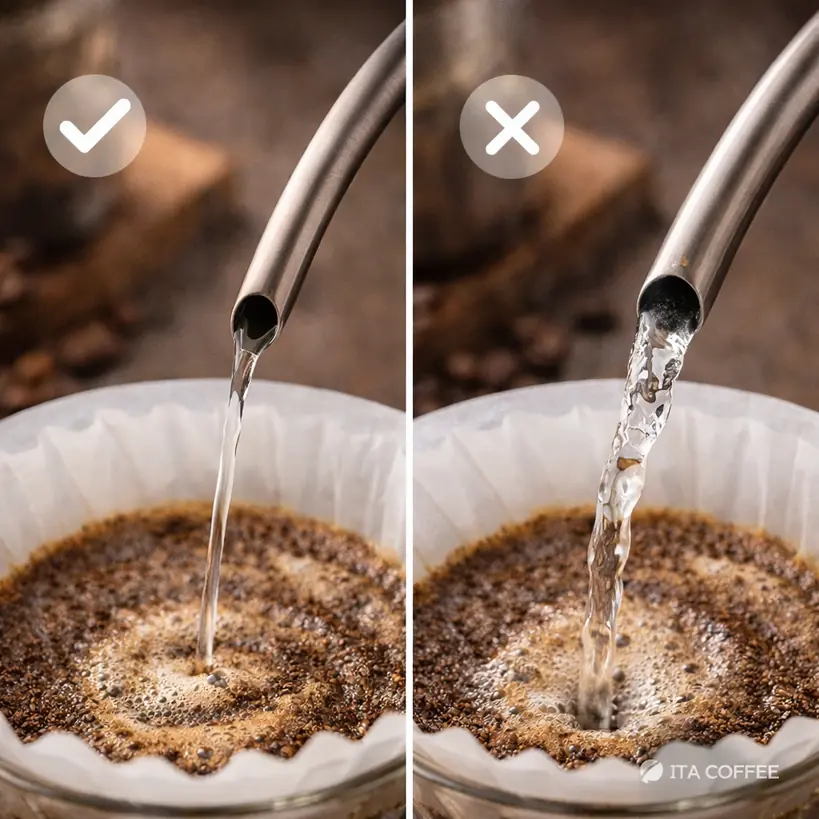
Key variables:
- Diameter: narrower = slower flow
- Length: longer = better control
- Angle: affects pour trajectory
A well-designed spout enables laminar flow (smooth, consistent stream), reducing turbulence and agitation.
2. Temperature Stability
Water temperature directly affects extraction efficiency.
- Higher temperature → faster extraction
- Lower temperature → slower extraction
As explained in Water Temperature for Coffee, even a 2–3°C change can shift flavor balance.
Kettles fall into two categories:
- Stovetop kettles: less precise, rely on user control
- Electric kettles: offer temperature control and stability
3. Pour Ergonomics (Control vs Fatigue)
Handle design affects how precisely you can pour.
Important factors:
- Handle position (center of mass alignment)
- Grip comfort
- Balance during tilt
Poor ergonomics lead to:
- Inconsistent flow
- Hand fatigue
- Loss of control during long pours
4. Flow Rate Range (Fine vs Coarse Control)
A good kettle should allow both:
- Low flow: bloom phase (gentle saturation)
- Moderate flow: main pours
This flexibility supports different brewing styles discussed in Coffee Brewing Basics.
5. Build Consistency and Heat Retention
Material affects thermal behavior:
- Stainless steel: stable, durable
- Thin metal: faster heat loss
Temperature drop during pouring can influence extraction consistency, especially in longer brews.
Types of Gooseneck Kettles (Use-Case Based)
1. Basic Stovetop Gooseneck Kettles
Characteristics:
- No temperature control
- Manual heating
- Simple construction
Best for:
- Beginners
- Low-frequency brewing
Limitation: inconsistent temperature management.
2. Electric Temperature-Control Kettles
Characteristics:
- Adjustable temperature (typically 60–100°C)
- Hold function
- Faster heating
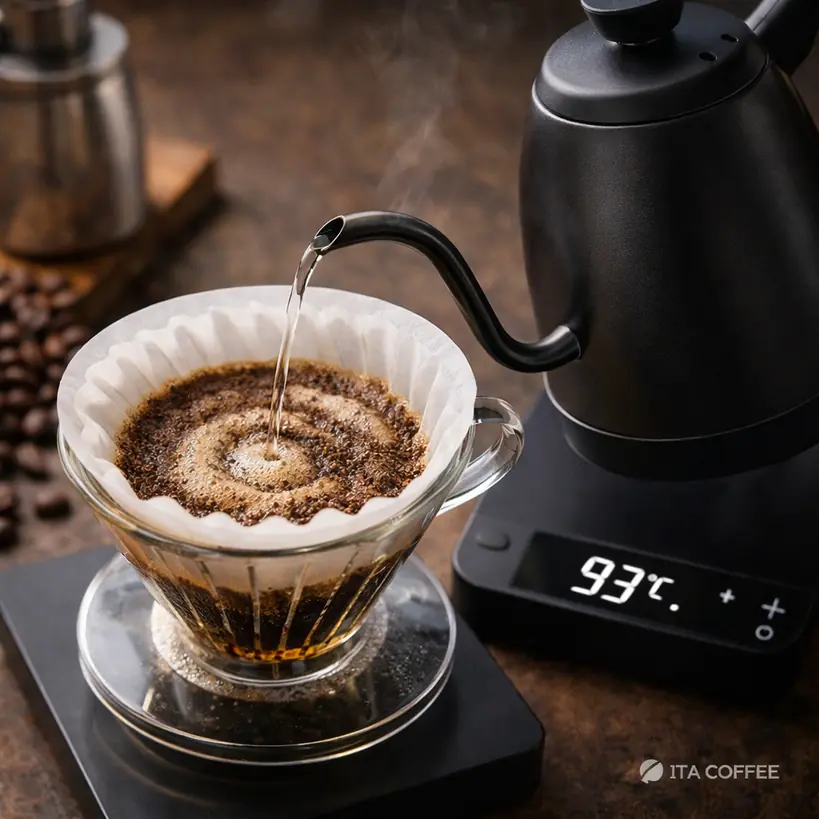
Best for:
- Pour over enthusiasts
- Recipe consistency
These kettles align with precision brewing approaches found in Coffee Extraction Explained.
3. High-Precision Flow-Control Kettles
Designed for advanced control:
- Ultra-stable spout geometry
- Balanced weight distribution
- Consistent flow across angles
Best for:
- Advanced users
- Competition-style brewing
Focus: repeatability and fine control.
Best Gooseneck Kettles: Practical Recommendations
Rather than ranking brands, we categorize kettles based on functional performance.
Best for Beginners
- Stable but forgiving flow
- Simple operation
- Moderate cost
Focus: learning pour control without complexity.
Best for Pour Over Precision
- Consistent flow rate
- Temperature control
- Good ergonomics
Focus: repeatable brewing and extraction accuracy.
Best for Advanced Control
- Highly stable spout
- Fine flow modulation
- Thermal consistency
Focus: controlling every variable in the brew process.
Common Mistakes When Choosing a Gooseneck Kettle
1. Ignoring Flow Behavior
Many users focus on appearance rather than flow characteristics. However, flow control is the primary function.
2. Overvaluing Temperature Precision Alone
Temperature matters, but without controlled pouring, extraction remains inconsistent.
3. Assuming Expensive Means Better Brewing
As explained in Why Expensive Coffee Gear Doesn’t Fix Bad Coffee, technique and understanding matter more than price.
4. Poor Pour Technique
Even with a good kettle, improper pouring can cause:
- Uneven saturation
- Channeling
- Flavor imbalance
Conclusion: Choosing the Best Gooseneck Kettle
The best gooseneck kettle is not defined by brand, but by how effectively it allows you to control:
- Flow rate
- Pour precision
- Temperature stability
In practical terms:
- If you want consistency → prioritize stable flow
- If you brew pour over → prioritize temperature + control
- If you refine technique → prioritize ergonomics and precision
A gooseneck kettle is one of the few tools that directly shapes how extraction happens in real time.
At ITA Coffee, we encourage you to treat pouring as a controlled variable, not a casual action. Practice different flow rates, observe how agitation changes flavor, and refine your technique systematically. For deeper understanding, explore our Coffee Knowledge and Brewing Guides sections.
Internal Links Log
- “What Is Percolation Brewing?” → https://www.itacoffee.com/what-is-percolation-brewing-science/
- “under vs over extraction” → https://www.itacoffee.com/under-vs-over-extraction-explained/
- “Pour Over (V60) Brewing Guide” → https://www.itacoffee.com/pour-over-v60-brewing-guide-a-clear-practical-method/
- “Water Temperature for Coffee” → https://www.itacoffee.com/water-temperature-of-coffee/
- “Coffee Brewing Basics” → https://www.itacoffee.com/coffee-brewing-basics-grind-size-ratio-and-time/
- “Coffee Extraction Explained” → https://www.itacoffee.com/coffee-extraction-explained/
- “Why Expensive Coffee Gear Doesn’t Fix Bad Coffee” → https://www.itacoffee.com/why-expensive-coffee-gear-doesnt-fix-bad-coffee/