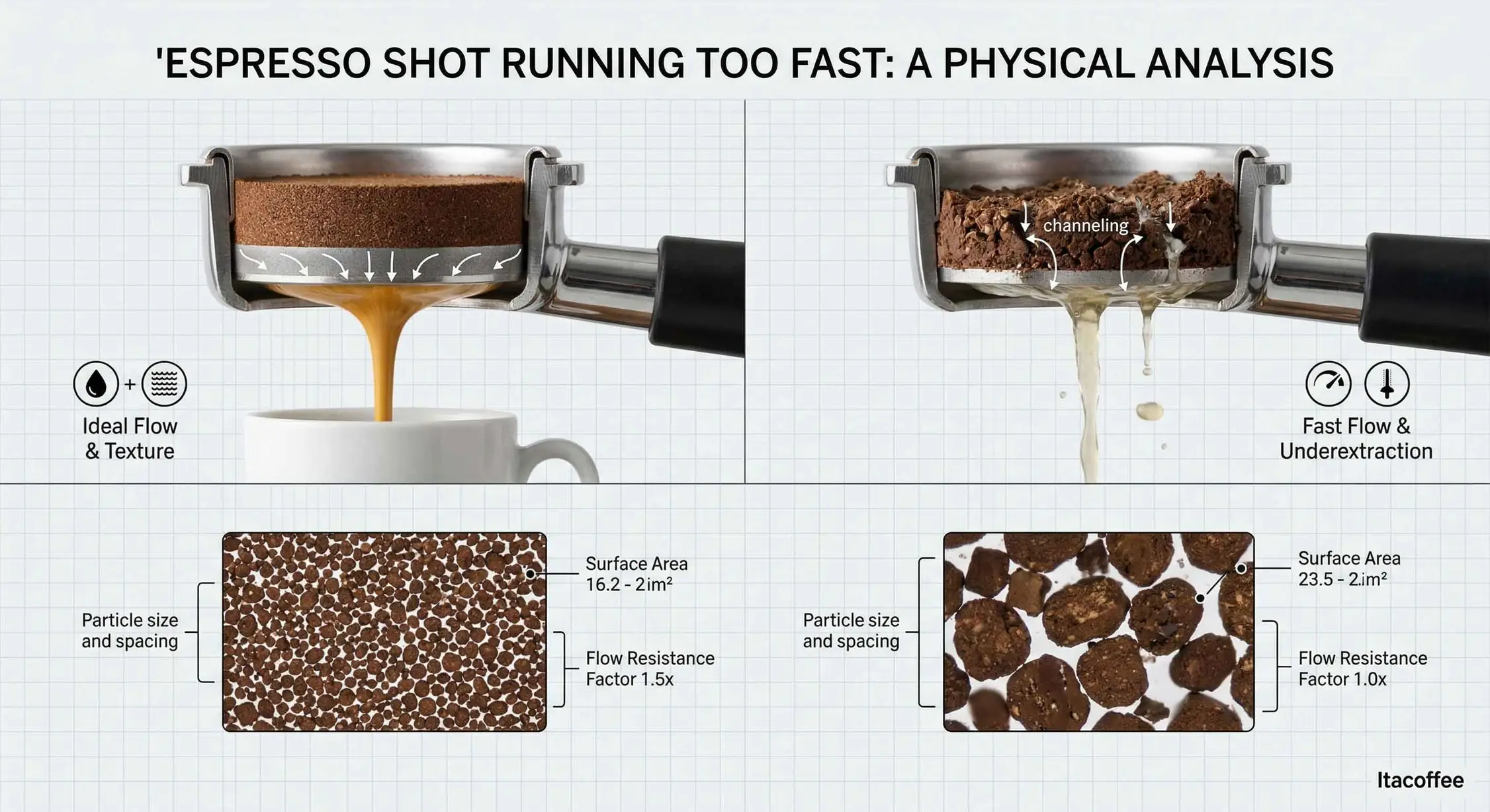
An espresso shot running too fast represents a fundamental failure in physical resistance.
In the mechanics of espresso brewing, water is introduced to a compacted bed of finely ground coffee at high pressure—traditionally 9 bars, or roughly 130 pounds per square inch. The coffee puck’s sole mechanical purpose is to resist that incoming water. When you observe an espresso shot running too fast (typically yielding your target weight in under 20 seconds), the water has encountered insufficient structural resistance.
Timing is not an arbitrary rule; it is an indicator of water contact time. A rapid flow rate guarantees inadequate solvent-to-solute contact, leading to severe under-extraction. To correct this, we must systematically analyze the variables that create puck resistance: grind size, dose, puck integrity, and bean chemistry.
In This Guide
The Physics of Puck Resistance
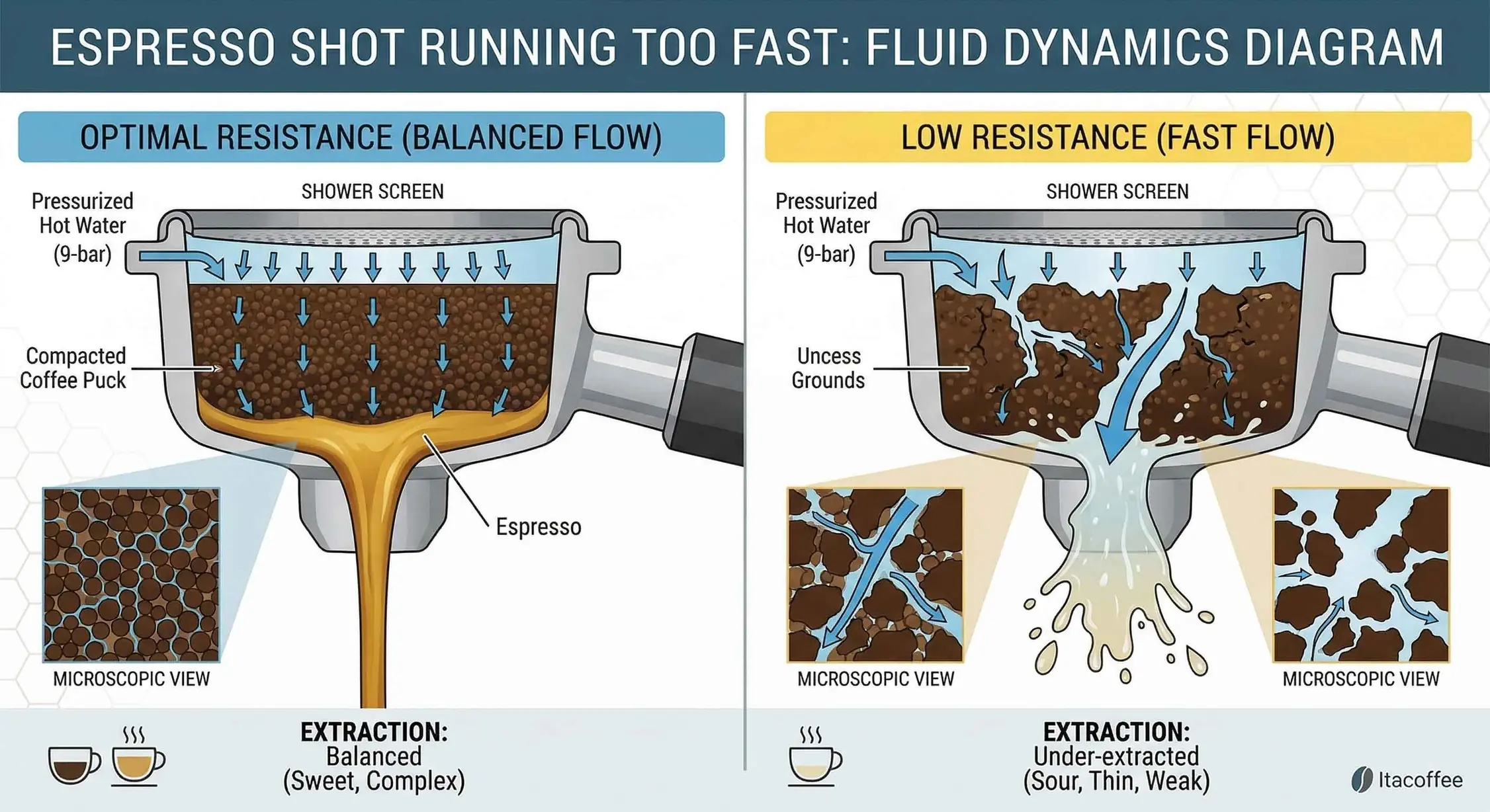
Water under pressure follows strict fluid dynamics: it will always seek the path of least resistance.
In an optimal espresso extraction, the resistance of the coffee bed forces the pressurized water to distribute evenly across the entire surface area. The water slowly permeates the dense cellular structure of the coffee grounds, dissolving acids, sugars, and complex aromatics at a controlled rate before exiting the portafilter.
When an espresso shot running too fast occurs, it means the physical barrier has been compromised. The water moves through the coffee bed with excessive velocity, bypassing the necessary chemical reactions required for a balanced cup.
Variable 1: Grind Size and Surface Area
The most common and most impactful reason for a fast flow rate is a grind size that is too coarse.
Coffee grounds are irregular, multifaceted particles. When ground coarsely, the physical gaps (interstitial spaces) between the particles are relatively large. Because water takes the easiest path, it rushes through these macroscopic gaps without effectively penetrating the cellular structure of the coffee particles themselves.
- The Mechanism: Adjusting your grinder to a finer setting reduces the size of the individual particles. This allows the particles to pack more densely together, shrinking the interstitial gaps and exponentially increasing the total surface area.
- The Result: The increased surface area creates higher friction against the water, physically slowing its descent and increasing contact time.
If you are constantly struggling with grind adjustments, it is critical to ensure your equipment is capable of micro-adjustments. To understand more about how grinder mechanics impact your extraction, review our analysis on common home brewing mistakes.
Variable 2: Dose and Headspace
If your grind size is appropriately fine but you still have an espresso shot running too fast, your dose (the dry weight of the coffee) may be inadequate for your specific filter basket.
Every espresso basket is engineered for a specific volume (e.g., 18 grams, 20 grams). The relationship between the dose and the basket determines the headspace—the gap between the surface of the tamped coffee puck and the dispersion screen of the espresso machine.
- Too Much Headspace: If you dose 15 grams into a 20-gram basket, the headspace is excessive. When the pump engages, water floods into this large gap, building turbulence before it even hits the coffee. This turbulence degrades the surface of the puck, eroding its structural integrity and causing the water to wash through rapidly.
- Lack of Depth: Furthermore, a lower dose physically creates a shallower coffee bed. A shallower bed inherently offers less vertical distance for the water to travel, meaning less resistance and a faster flow rate.
Precision is non-negotiable here. To lock in this variable, read our guide on the science of precision brewing.
Variable 3: Channeling and Distribution
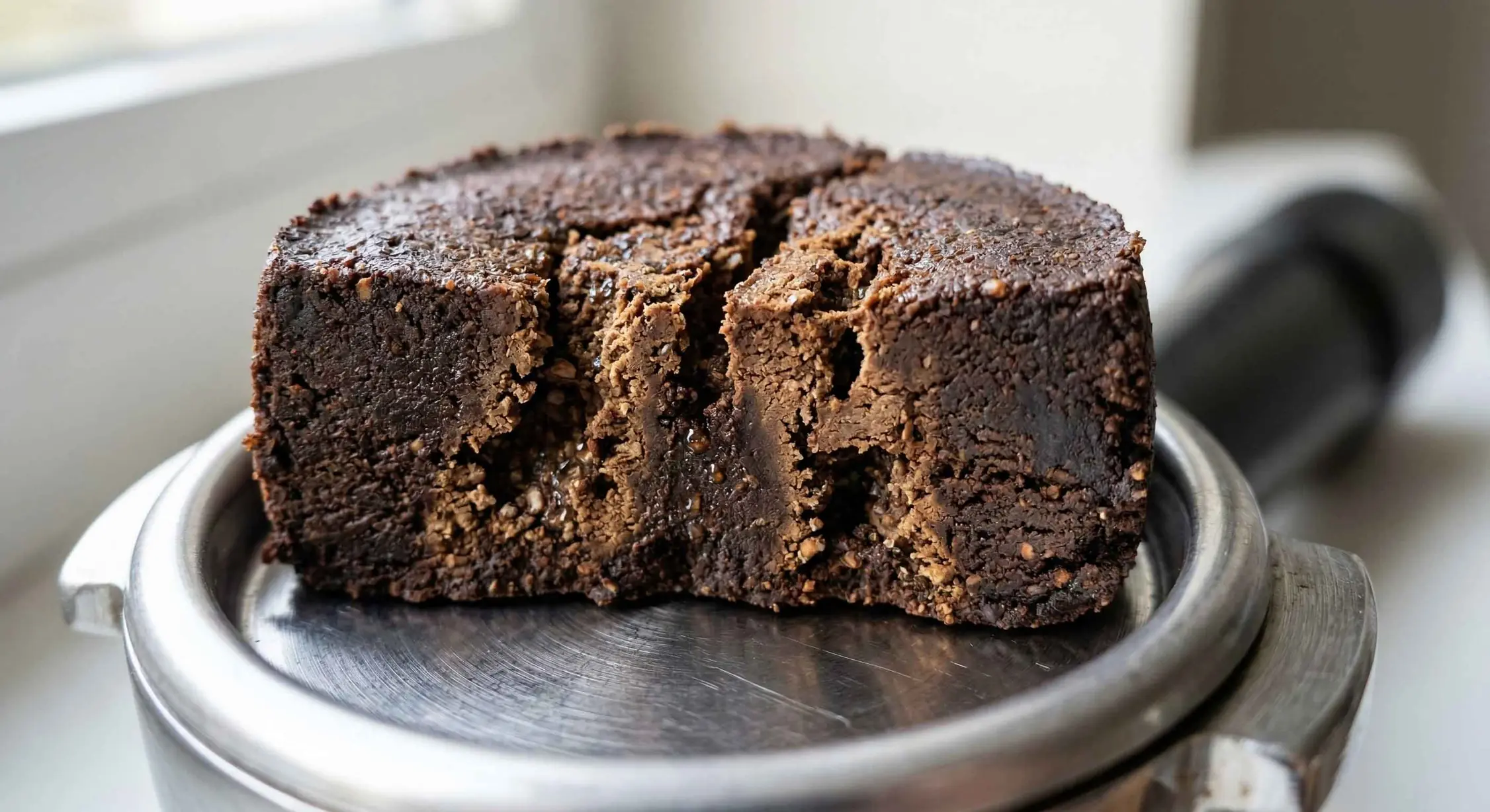
Sometimes, your dose and grind size are mathematically correct, yet the shot gushes out in 12 seconds. This is almost certainly caused by channeling.
Channeling happens when the density of the coffee bed is uneven. If there are clumps in the grounds, or if the tamp was unlevel, one side of the puck will be less dense than the rest. The 9 bars of pressure will instantly exploit this weak point, carving a high-velocity localized channel straight through the coffee bed.
While the majority of the puck remains untouched (dry and un-extracted), the water violently rushes through this single channel.
To prevent this, you must prioritize proper puck preparation:
- De-clumping: Use a WDT (Weiss Distribution Technique) tool—a set of thin needles—to rake through the grounds, breaking up localized densities and homogenizing the bed.
- Level Tamping: Apply firm, perfectly horizontal pressure to eliminate air pockets. Note: Tamping harder does not slow down an espresso shot; it merely removes the air. Once the air is gone, the coffee cannot be compressed further.
Variable 4: Coffee Freshness and Carbon Dioxide (CO2)
The age of your coffee beans dramatically influences flow rate, independent of your grinder settings.
During the roasting process, carbon dioxide (CO2) is trapped within the cellular matrix of the coffee bean. When hot, pressurized water hits fresh coffee grounds, this CO2 rapidly expands and attempts to escape. As it does, it emulsifies with the coffee’s insoluble oils to form crema.
More importantly for flow rate, this active expansion of gas creates a highly viscous, turbulent physical barrier that actively pushes back against the incoming water.
As coffee sits over weeks or months, it slowly degasses.
- Fresh Coffee: High CO2 content creates strong internal resistance, slowing the shot.
- Stale Coffee: Minimal CO2 content offers zero gas resistance. The water will flow through stale coffee significantly faster than fresh coffee, even if the grind and dose are identical.
For a deeper dive into how chemical degradation affects your brewing, study the chemistry of staling and extraction.
The Flavor Consequences of a Fast Flow Rate
An espresso shot running too fast guarantees under-extraction. Because the solvent (water) spends insufficient time in contact with the solute (coffee), it cannot dissolve the full spectrum of flavor compounds.
Extraction happens sequentially. Organic acids and salts dissolve almost immediately upon contact with water. Sugars require more time and energy to break down. Complex carbohydrates and bitter alkaloids dissolve last.
If your shot finishes in 15 seconds, you have only extracted the initial layer of acids. The resulting espresso will exhibit:
- A sharply sour, astringent profile (often confused with bitterness by beginners, but technically highly acidic).
- A thin, watery body lacking the syrupy viscosity characteristic of proper espresso.
- A complete lack of sweetness, as the sugars were left behind in the portafilter.
If your coffee exhibits these traits, consult our troubleshooting guide on why coffee tastes weak or hollow.
Step-by-Step Diagnostic Protocol
To effectively fix an espresso shot running too fast, you must isolate your variables. Never change your dose and your grind size at the same time. Follow this logical sequence:
Step 1: Fix the Dose
Use a digital scale to weigh your coffee precisely (e.g., 18.0 grams). Do not alter this weight for the remainder of the diagnostic process. Consistency here establishes your baseline.
Step 2: Adjust the Grind Size
Move your grinder collar toward the “fine” setting. Make a deliberate adjustment, not a microscopic one. Purge approximately 3 to 5 grams of coffee through the grinder to remove the previous coarse grounds from the internal retention chamber.
Step 3: Prepare the Puck Meticulously
WDT the grounds to ensure uniform density, then tamp perfectly level.
Step 4: Pull and Measure
Place a scale under your cup. Start the pump and a timer simultaneously. Aim for a 1:2 ratio (e.g., 18g in, 36g out). If the shot hits 36g in less than 25 seconds, repeat the process and grind finer. If the machine chokes and no coffee comes out, you have ground too fine; back off slightly.
Final Thought
An espresso shot running too fast is a mechanical issue, not a subjective preference.
Do not rely on altering your water temperature or buying aftermarket dispersion screens to fix a fundamental lack of resistance. Lock your dose to match your basket, meticulously eliminate channeling through proper distribution, and use your grinder to dictate the exact flow rate. Control the physics, and you will control the flavor.
— ITA Coffee | Brewing Guides for Curious, Thoughtful Coffee Makers
Editorial note: This article was developed with AI-assisted drafting and human review to ensure clarity, accuracy, and a non-commercial educational tone.