A structural guide to understanding coffee channeling—one of the most common causes of uneven espresso extraction.
Coffee channeling occurs when brewing water finds low-resistance pathways through the coffee puck instead of extracting evenly. This uneven flow leads to simultaneous over-extraction and under-extraction, producing espresso that tastes both sour and bitter.
Many coffee brewers encounter a confusing problem:
- The shot starts too fast
- Flavor is both sour and bitter at the same time
- The espresso stream looks uneven or spraying
These symptoms are rarely random. In most cases, they point to a specific extraction defect called channeling.
Channeling occurs when water finds low-resistance pathways through the coffee bed instead of extracting evenly. The result is a cup where some grounds are over-extracted while others remain under-extracted.
If you’re unfamiliar with how extraction works in general, start with our guide on coffee extraction explained, which breaks down how water dissolves flavor compounds from coffee.
Once that foundation is clear, channeling becomes much easier to diagnose and fix.
In This Guide
What Is Coffee Channeling?
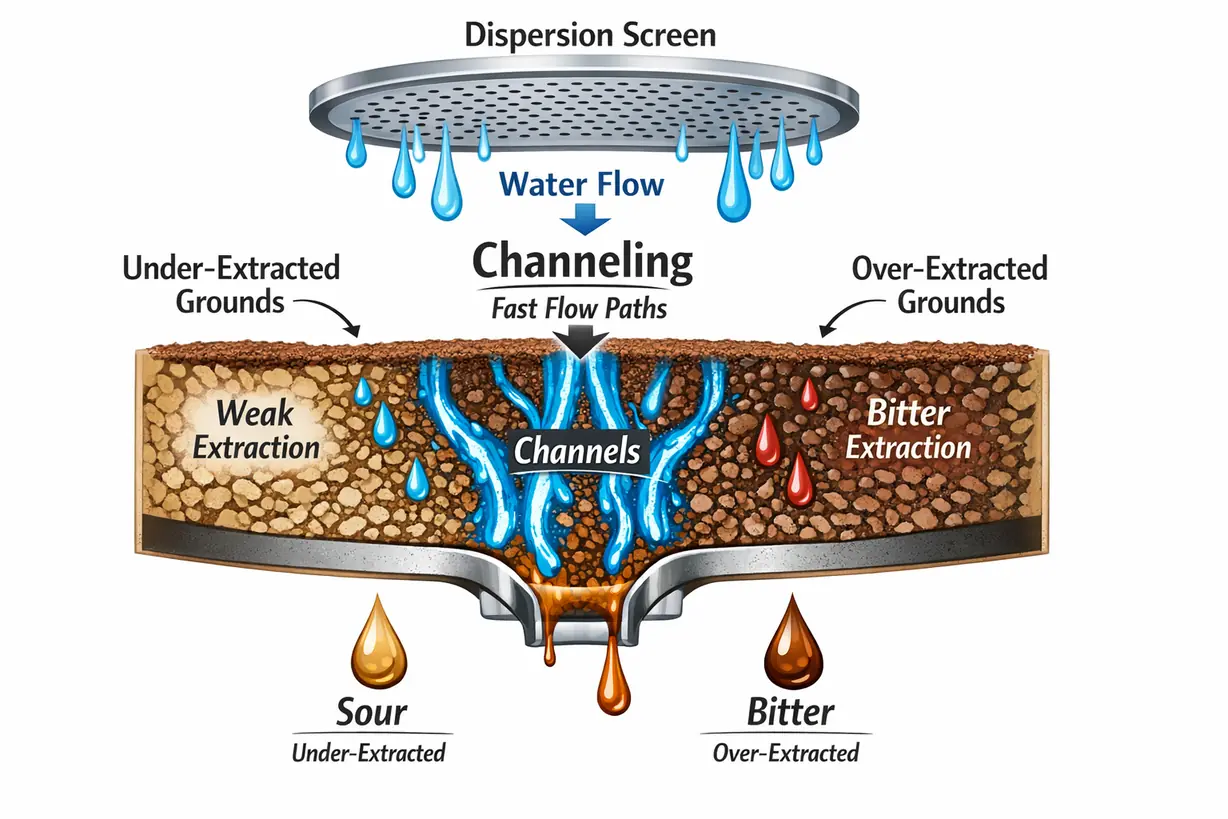
Channeling refers to the formation of narrow pathways inside the coffee bed where water flows faster than the surrounding areas.
Instead of passing uniformly through the grounds, water concentrates in specific routes—called channels—which dramatically alters extraction balance.
Why Channels Form
Water naturally follows the path of least resistance. If the coffee bed contains areas that are:
- Less dense
- Poorly distributed
- Cracked or uneven
water accelerates through those weak points, leaving the surrounding coffee under-extracted.
This is why channeling is primarily a physical problem, not just a taste issue.
Why Channeling Happens (The Physics of Uneven Flow)
To understand channeling, imagine the coffee puck as a porous filter.
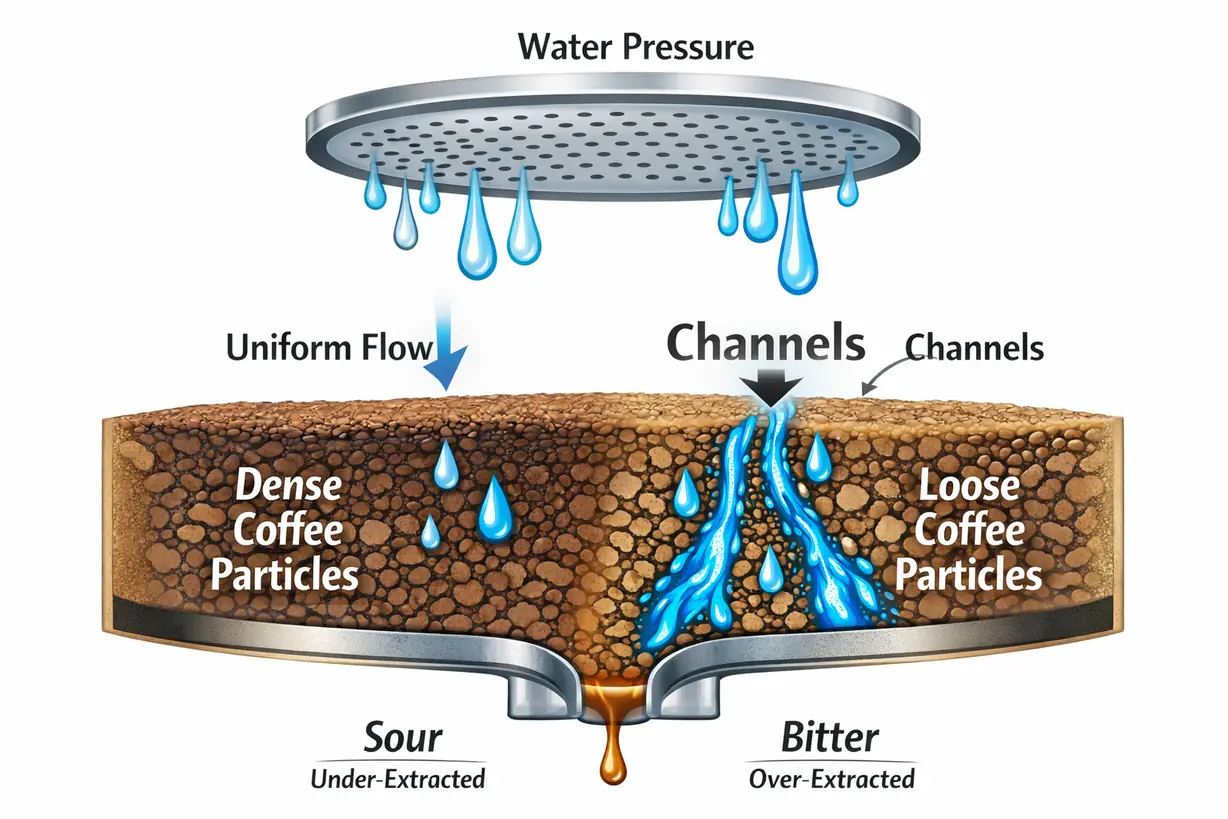
Water pressure (from an espresso machine) attempts to push liquid through thousands of tiny gaps between coffee particles.
If the particle distribution is uniform, water moves evenly across the entire puck.
If the structure is uneven, pressure concentrates into small tunnels.
What Happens During Channeling
Three extraction zones appear simultaneously:
- Channel areas → severe over-extraction
- Adjacent areas → partial extraction
- Untouched regions → under-extraction
This produces the classic flavor contradiction:
- Sourness from under-extracted grounds
- Harsh bitterness from over-extracted zones
For a deeper look at these taste defects, see why coffee tastes bitter or sour.
Signs of Channeling During Espresso Extraction
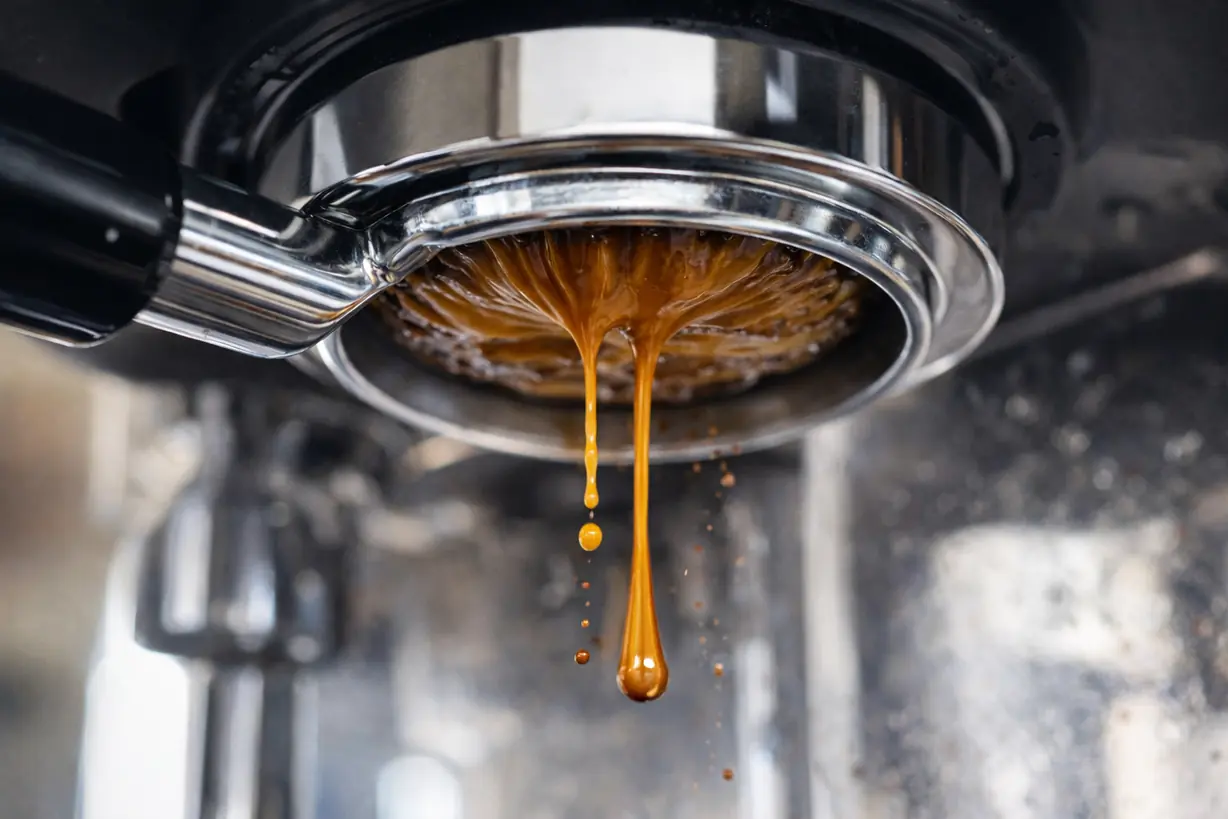
In espresso, channeling often becomes visible.
Typical visual indicators include:
- Spraying or sideways jets from the portafilter
- Uneven flow from a bottomless portafilter
- A shot that starts very fast but finishes weak
If the shot runs too quickly overall, it may also relate to grind size or puck structure.
This troubleshooting guide explains the mechanics in detail: espresso shot running too fast
Quick Channeling Diagnosis
| Symptom | Likely Cause |
|---|---|
| Spraying espresso | Uneven distribution or clumping |
| Shot starts too fast | Grind too coarse or channeling |
| Flow appears from one side | Uneven tamp |
| Sour and bitter flavor together | Mixed extraction due to channels |
Common Causes of Coffee Channeling
Channeling is usually caused by poor puck preparation rather than equipment.
1. Uneven Coffee Distribution
If grounds are clumped or piled unevenly in the basket, tamping cannot correct the density difference.
Water will exploit those weak areas immediately.
2. Inconsistent Grind Size
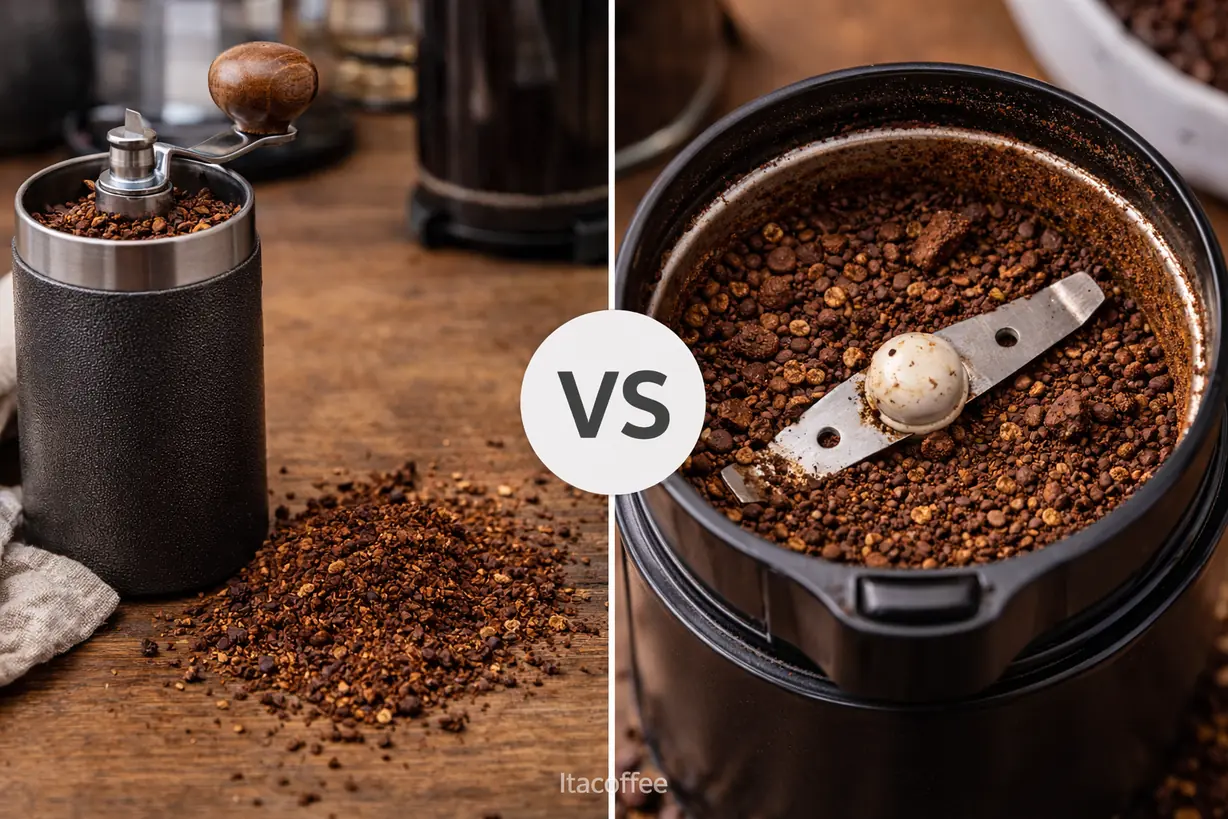
Grinders that produce irregular particles create structural instability in the puck.
Fine particles slow water, while larger particles allow faster flow—creating pressure gradients that initiate channels.
If you’re still building your brewing foundation, our guide on coffee brewing basics explains how grind size interacts with extraction time and flow.
3. Poor Tamping Technique
A tilted or uneven tamp compresses one side of the puck more than the other.
Water will flow toward the less compressed region.
4. Cracks in the Coffee Puck
Cracks may form when:
- Distribution is uneven
- The puck is knocked before brewing
- The basket is overfilled
Even small cracks act like highways for pressurized water.
How to Prevent Channeling in Espresso
Preventing channeling is mainly about creating a uniform coffee bed.
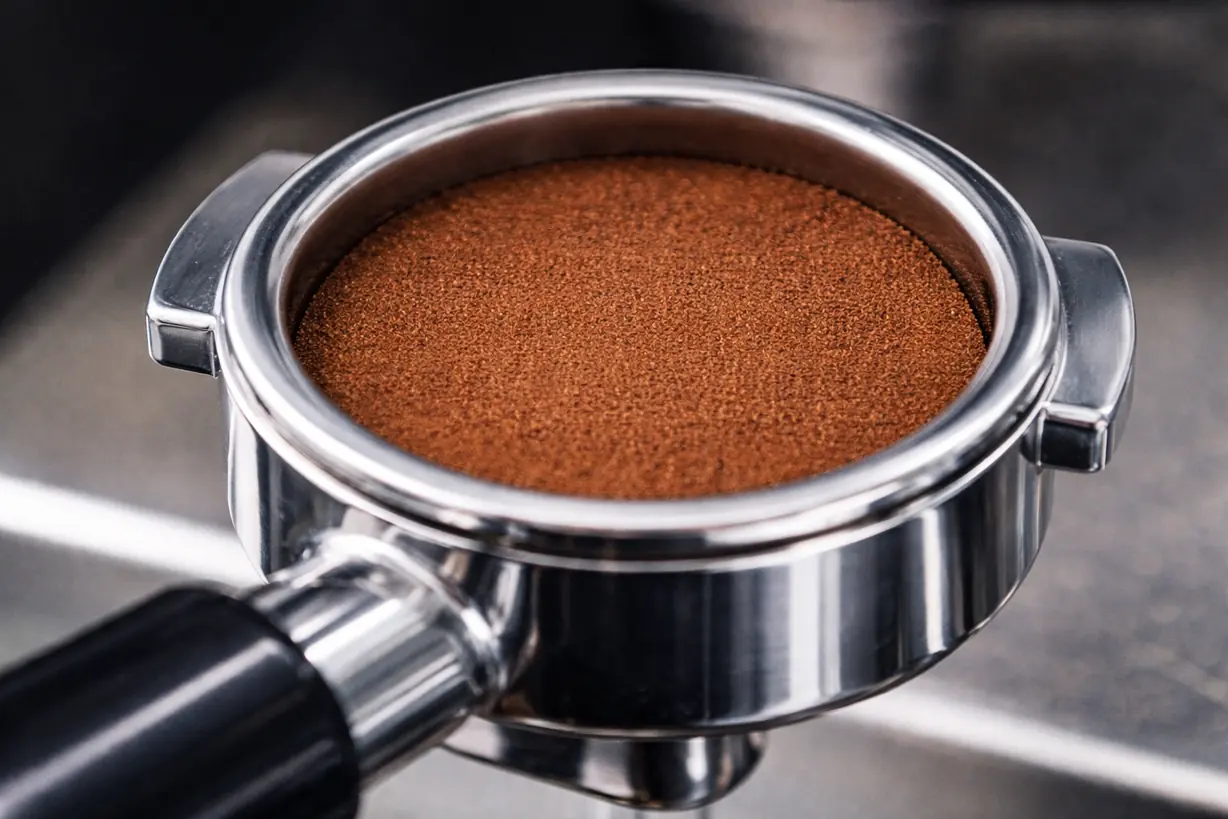
Step 1: Distribute the Grounds Evenly
Before tamping, ensure coffee is level in the basket.
Common techniques include:
- Gentle tapping to settle grounds
- Using a distribution tool
- Manual stirring (WDT technique)
Step 2: Tamp Level and Consistently
The goal of tamping is not extreme pressure—it is uniform density.
Apply steady downward force while keeping the tamper perfectly level.
Step 3: Control Grind Size
Grind size determines resistance in the coffee bed.
If the grind is too coarse, water accelerates and channels more easily.
For espresso fundamentals, see our detailed guide on how to make espresso.
Does Better Equipment Prevent Channeling?
Better grinders and distribution tools can improve consistency, but they do not eliminate channeling by themselves. Channeling is primarily a problem of puck preparation and particle distribution. Even professional machines can produce severe channeling if the coffee bed is uneven.
Channeling in Pour-Over and Other Brewing Methods
Channeling is not limited to espresso.
It can also occur in manual brewing methods such as:
- Pour-over coffee
- Immersion brewers with uneven saturation
- Automatic drip machines with poor shower head distribution
In pour-over brewing, uneven pouring can create similar preferential pathways in the coffee bed.
Our full guide on pour over V60 brewing explains how controlled pouring helps maintain even extraction.
Why Channeling Ruins Coffee Flavor
Coffee flavor depends on balanced extraction.
When channeling occurs, extraction becomes fragmented:
- Some grounds release too many bitter compounds
- Others release almost none
The cup therefore loses clarity, sweetness, and structure.
Balanced extraction does not require expensive equipment. It requires a coffee bed that allows water to move evenly and predictably.
Key Takeaway
- Channeling is a structural extraction problem.
- Water always follows the path of least resistance.
- Even small improvements in distribution and tamping can dramatically improve extraction balance.
Final Thoughts from itacoffee
Channeling is not a mysterious defect—it is simply a consequence of uneven physics inside the coffee bed.
Once you understand that water always follows the path of least resistance, the solution becomes straightforward:
- Grind consistently
- Distribute evenly
- Tamp level
At itacoffee, the goal is not to chase equipment upgrades but to understand the structure of extraction itself.
Practice observing your puck preparation and extraction flow.
Small improvements in uniformity often produce the largest improvements in flavor.
— itacoffee | Brewing Guides for thoughtful coffee makers
This article was written and optimized with the assistance of AI, then reviewed and structured for clarity and educational accuracy.