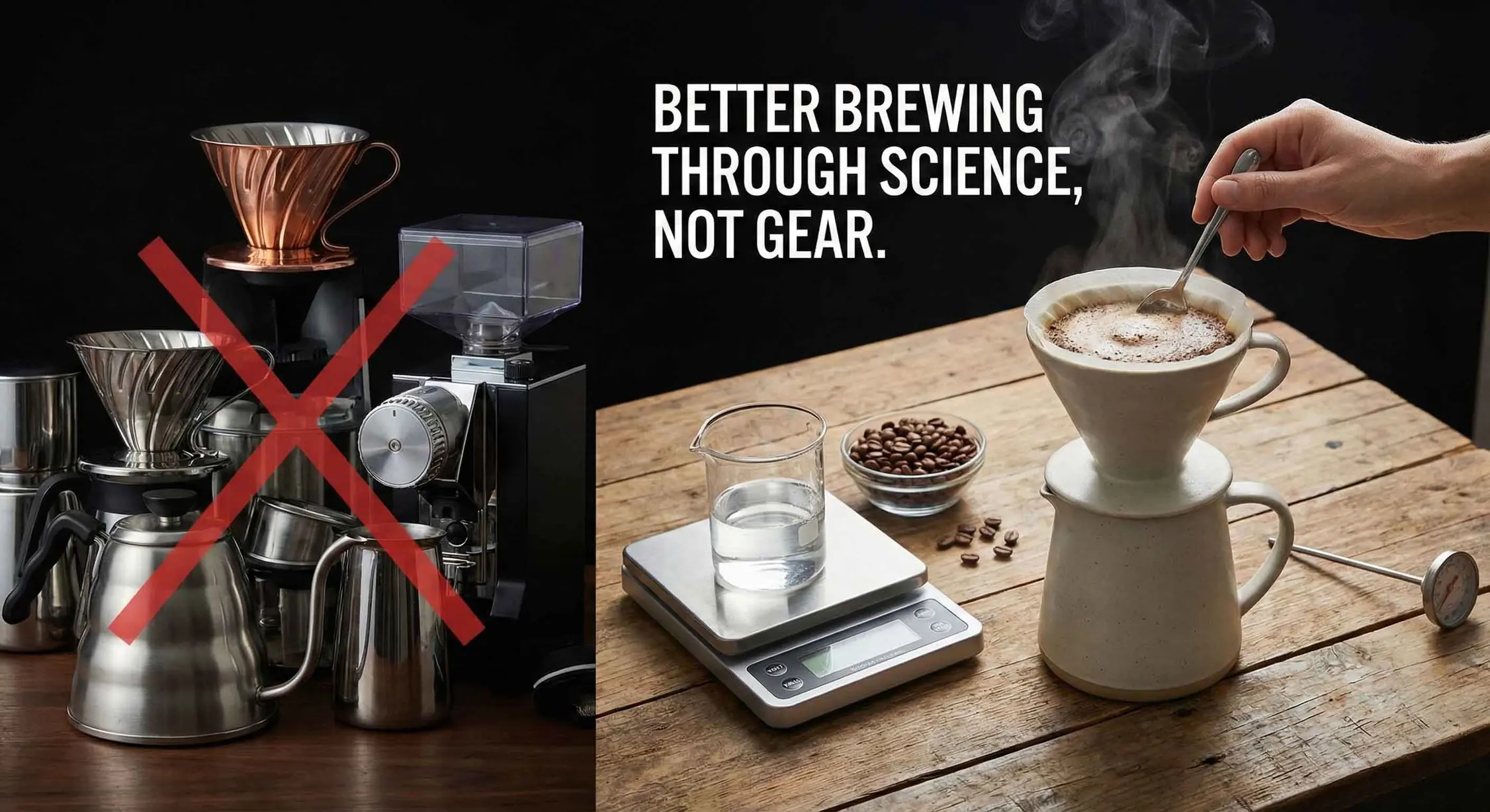
In the pursuit of laboratory-level precision in coffee brewing, many home brewers fall into a predictable trap: attempting to solve fundamental extraction errors by purchasing more expensive grinders or drippers. When your daily cup presents as overwhelmingly bitter, sharply sour, or structurally hollow, it is rarely a failure of your equipment. It is an objective failure in managing the physics and chemistry of extraction.
Brewing gear merely provides stability for your variables. If you do not understand how water acts as a solvent to extract soluble compounds from roasted coffee seeds, upgrading your tools will only yield consistently bad results. By analyzing the mechanical and thermal variables of brewing, we can drastically improve your cup quality without any financial investment. This scientific reality highlights exactly why expensive coffee gear doesn’t fix bad coffee.
In This Guide
Strategy 1: Establish a Physical Baseline via Fixed Mass
The foundation of any extraction analysis relies on a constant ratio of mass. Many home brewers sabotage their brew by intuitively varying the amount of coffee grounds or water daily. This causes the total dissolved solids (TDS) and extraction yield (PE) to fluctuate randomly.
- The Scientific Consequence: When you alter both water and coffee mass simultaneously, the solvent’s carrying capacity for the solute changes non-linearly. This makes it impossible to systematically diagnose whether your brew is suffering from under-extraction or over-extraction.
- The Zero-Cost Solution: Mandate a strict gravimetric ratio (e.g., 1:15) using a basic kitchen scale. Do not alter this ratio until you fully grasp the technical guide to coffee brewing ratios. Establishing this constant is the first step in stripping away extraction uncertainty.
Strategy 2: Manage Thermodynamics and Thermal Decay
Coffee extraction is an endothermic process dependent on heat energy. The temperature of your water dictates molecular kinetic energy, which determines the dissolution rate of specific flavor compounds.
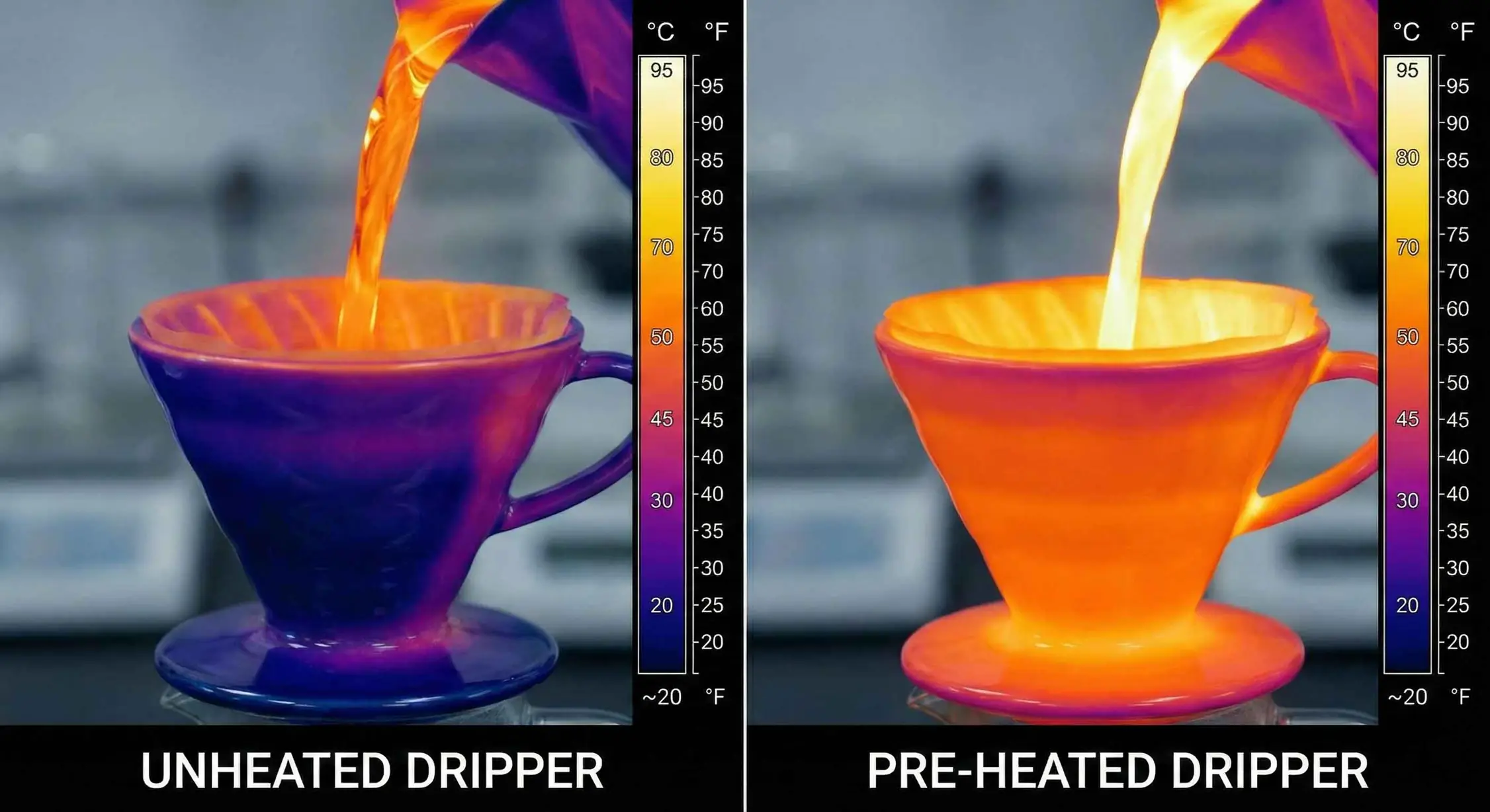
A prevalent mechanical error at home is brewing into cold ceramic or glass vessels. A cold dripper instantly acts as a heat sink, stripping thermal energy from the brewing slurry and causing a severe drop in the actual extraction temperature.
- Loss of High-Molecular-Weight Compounds: The Maillard reaction products and caramelized sugars that provide body and sweetness require sustained high heat to dissolve.
- Consequences of Rapid Cooling: If the slurry temperature decays too quickly, extraction prematurely halts. You are left primarily with highly soluble organic acids, resulting in a thin, astringent, and sour cup.
Pre-heat your dripper and carafe thoroughly with boiling water for at least 30 seconds before brewing. To master thermal stability without buying a temperature-controlled kettle, review our science-backed rules for water temperature.
Strategy 3: Optimize Fluid Dynamics (The Bloom)
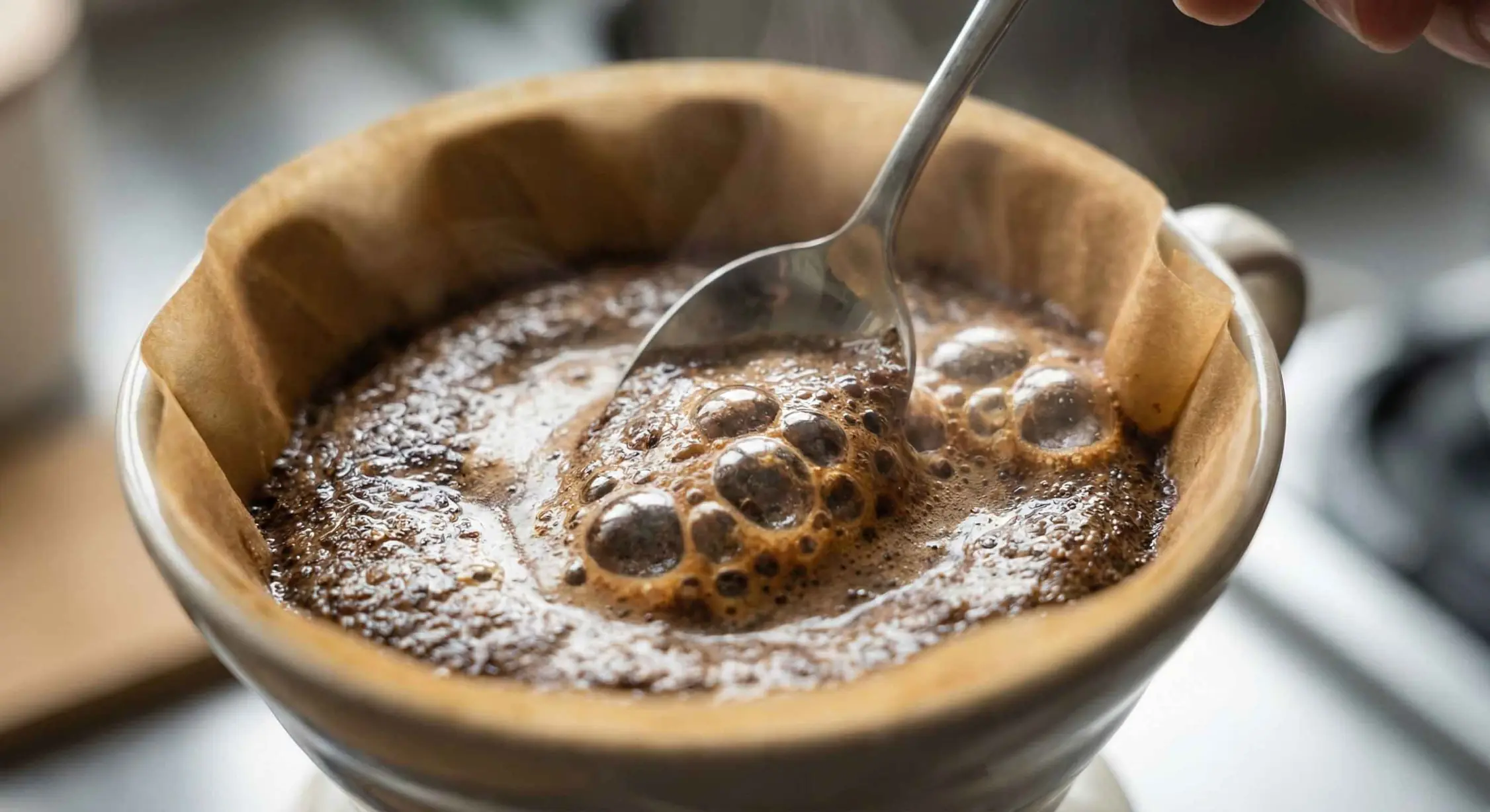
Freshly roasted coffee cellular structures contain trapped carbon dioxide (CO2). During the initial stage of brewing, an un-degassed coffee bed is highly hydrophobic. If water is just poured indiscriminately, it will seek the path of least resistance, creating channeling. This leaves parts of the coffee bed over-extracted (bitter) and other parts completely dry (unextracted).
You do not need an expensive gooseneck kettle to fix this; you simply need to optimize the fluid dynamics during the “bloom” phase:
- Mechanical Action: Pour 2 to 3 times the dry coffee weight in water, and immediately apply gentle physical agitation (using a small spoon or aggressively swirling the brewer) within the first 10 seconds.
- Chemical Reaction: This forced agitation expels the gaseous CO2, ensuring the liquid solvent can uniformly penetrate all solid surfaces during subsequent pours. For a deeper understanding of this reaction, explore why fresh coffee bubbles and why blooming matters.
Strategy 4: Recalibrate Water Contact Time
If you are pouring from a standard kettle instead of a precision gooseneck, the gravitational force and volume of the water stream will violently disrupt the coffee bed structure. Pouring from too high or too fast forces “fines” (micro-particles of coffee) to migrate to the bottom of the filter, clogging the pores. This halts the flow rate, extends water contact time indefinitely, and guarantees over-extraction.
The Zero-Cost Fix:
Lower your pouring height to sit just above the coffee bed. Break your total water volume into 3 or 4 smaller, controlled pulses (Pulse Pouring) poured gently in the center. By manually controlling the water level, you dictate the contact time, bypassing the need for specialized pouring equipment.
Brewing Errors vs. Scientific Corrections
| Common Home Brewing Error | Scientific Consequence | Zero-Cost Correction |
|---|---|---|
| Volumetric/Guesswork Measuring | Unpredictable solvent-to-solute ratio leading to chaotic TDS. | Lock in a fixed ratio (e.g., 1:15) using a standard kitchen scale. |
| Skipping Vessel Pre-heating | Rapid thermal decay preventing the extraction of sweet, heavy compounds. | Pre-heat all contact surfaces with boiling water for 30 seconds. |
| Passive Blooming | Hydrophobic CO2 pockets cause channeling and dry spots. | Apply physical agitation (swirling/stirring) to force 100% saturation. |
| High/Aggressive Pouring | Fines migration clogs the filter, artificially extending contact time. | Pour low and use segmented pulse-pouring to control flow rate. |
Conclusion
A disappointing cup of coffee is never an excuse to immediately buy a new grinder or an artisanal dripper. It is simply data indicating that your physical and thermodynamic variables have slipped out of control. When you learn to anchor your brew with a fixed ratio, combat thermal decay with pre-heating, and optimize fluid dynamics through agitation, you transition from blindly making coffee to directing a controlled chemical extraction.
Your objective as a home brewer is to analyze the liquid in your cup and adjust the mechanics accordingly. Tomorrow morning, before browsing for new gear online, apply these strict physical constraints to your current setup and taste the objective difference.
— ITA Coffee | Brewing Guides for Curious, Thoughtful Coffee Makers
Editorial note: This guide focuses strictly on the physics and chemistry of coffee extraction. ITA Coffee remains committed to providing objective, teaching-oriented education free from commercial equipment bias.