In the pursuit of repeatable coffee quality, intuition is a poor substitute for measurement.
While variables like temperature and grind size are critical, coffee brew ratios serve as the structural blueprint of every cup.
Without clearly defined coffee brew ratios, extraction becomes unstable and impossible to evaluate consistently.
Coffee brew ratios describe the relationship between the weight of dry coffee grounds and the weight of water used for brewing.
Understanding coffee brew ratios allows brewers to control intensity (perceived strength) and influence extraction (the percentage of coffee solids dissolved into water).
This shift from intuition to calibration is what makes brewing repeatable.
Understanding this ratio allows a brewer to move from subjective guessing to objective calibration.
In This Guide
Why Coffee Brew Ratios Must Be Measured by Weight
Precision in brewing requires measuring by mass (grams), not volume (spoons or cups). Coffee beans vary significantly in density depending on origin and roast level.
A tablespoon of dark roast weighs less than a tablespoon of light roast because roasting expands the bean and reduces density.
For a deeper explanation of how roast development changes bean structure and solubility, see Dark Roast vs Light Roast: Structural Differences Explained.
A digital scale ensures the ratio remains constant regardless of bean expansion or grind variation.
Without weight measurement, consistency is mathematically impossible.
The Foundation of Coffee Brew Ratios
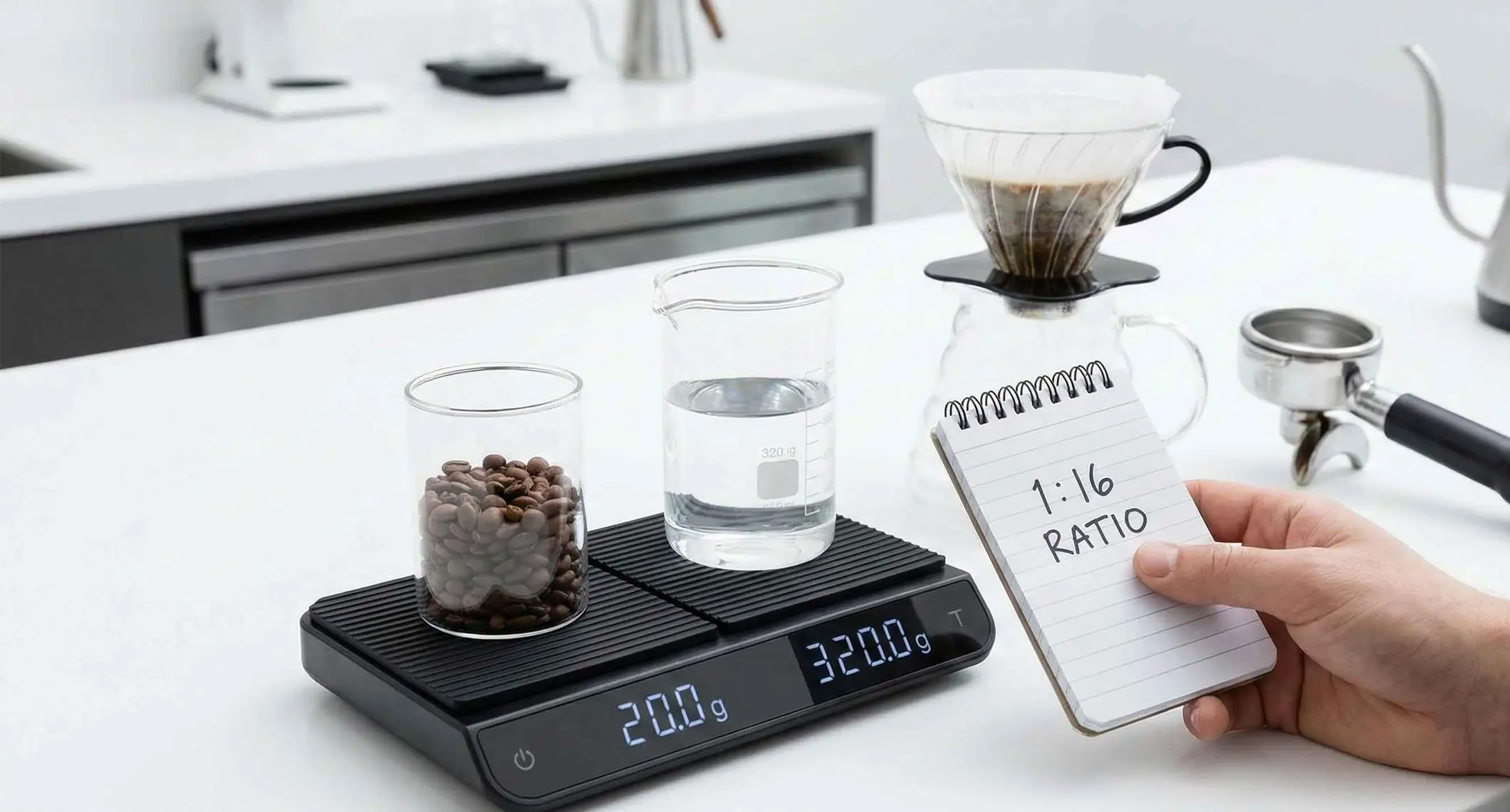
Ratios are typically expressed as 1:X, where “1” represents coffee mass and “X” represents water mass.
Example: A 1:16 ratio means 1 gram of coffee for every 16 grams of water.
If you use 20g of coffee:
- 1:15 → 300g water
- 1:16 → 320g water
- 1:17 → 340g water
This relationship governs two overlapping but distinct outcomes:
- Strength (TDS – Total Dissolved Solids): The concentration of dissolved material in the cup. A tighter ratio (e.g., 1:12) produces higher concentration.
- Extraction Yield: The percentage of the coffee’s mass dissolved into the brew. Ratio affects how efficiently water extracts soluble compounds.
For a detailed clarification between concentration and extraction percentage, see Is More Coffee Always Stronger? Strength vs Extraction Explained.
Common Brew Ratios by Brewing Method
Different brewing methods require different baseline ratios because of how water interacts with coffee.
The key distinction is whether the method uses immersion (soaking) or percolation (water flowing through the grounds).
You can explore the physical mechanics in Immersion vs Percolation: The Physics of Extraction.
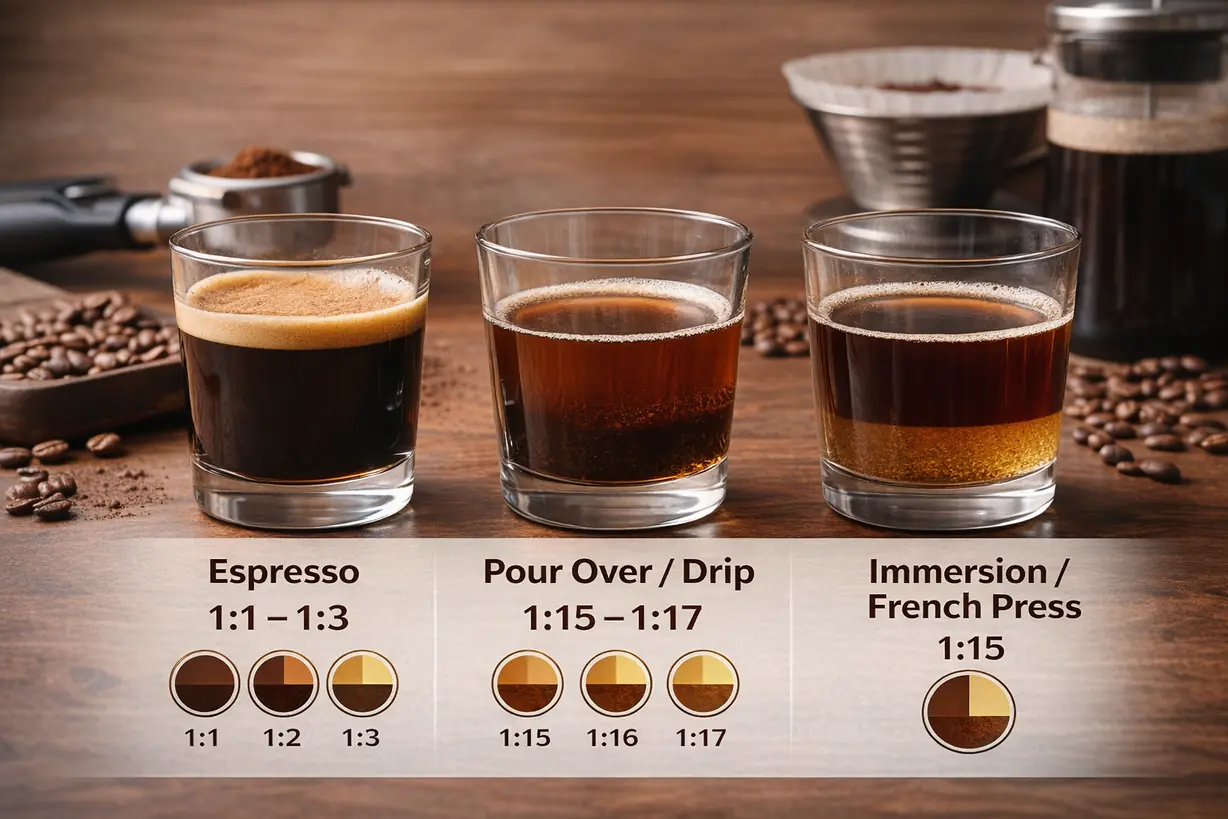
1. Espresso (1:1 to 1:3)
Espresso is a high-pressure, short-contact extraction. A standard “normale” shot typically follows a 1:2 ratio (e.g., 18g in → 36g out).
For a technical breakdown of grind size, pressure, and yield control, see How to Make Espresso: A Clear Fundamental Guide.
2. Pour Over / Drip (1:15 to 1:17)
The widely accepted filter range often falls between 1:15 and 1:17.
- 1:15 → fuller body, heavier mouthfeel
- 1:17 → lighter body, higher clarity
A structured method like the Pour Over V60 Practical Method
often performs reliably at 1:16 as a starting calibration point.
3. Immersion / French Press (1:15)
Immersion methods extract differently because water remains in contact with the grounds for the full brew time.
Since extraction efficiency is lower than percolation, a slightly tighter ratio such as 1:15 is often used to maintain body.
For a repeatable immersion workflow, see How to Brew Coffee with a French Press.
How Brew Ratio Influences Extraction Dynamics
Water acts as a solvent. Increasing water volume (e.g., 1:18) gives the solvent more capacity to dissolve compounds.
This can increase extraction yield but may produce a diluted mouthfeel.
Conversely, a tighter ratio (e.g., 1:13) saturates the solvent more quickly.
If grind size and temperature are not adjusted accordingly, this can produce under-extraction.
For a deeper chemical explanation of solubility curves and extraction phases, see Coffee Extraction Explained.
For industry reference standards on ideal extraction ranges and strength balance, see the Specialty Coffee Association Brewing Control Chart.
How to Adjust Your Brew Ratio Intelligently
Important principle: change only one variable at a time.
| Taste Result | Likely Cause | Ratio Adjustment |
|---|---|---|
| Thin, sour, weak | Low strength / Under-extraction | Decrease water (e.g., 1:17 → 1:15) |
| Bitter, harsh, dry | High extraction / Over-extraction | Increase water (e.g., 1:15 → 1:17) |
Frequently Asked Questions About Brew Ratios
Does the ideal ratio change with roast level?
The ratio itself is mathematical, but darker roasts are more soluble.
Many brewers use slightly more water for light roasts to encourage extraction and slightly tighter ratios for dark roasts to limit bitterness.
Should I measure input water or output beverage?
In filter brewing, measure total input water.
In espresso, measure beverage output (yield), because a significant portion of water remains absorbed by the coffee puck.
Final Thought from ITA Coffee
A brew ratio is not a rigid rule. It is a calibration baseline.
Once fixed, you can adjust grind size, temperature, and time with clarity.
Without a fixed ratio, you are attempting to solve a system with too many moving variables.
Start with 1:16 for filter coffee and 1:2 for espresso. Observe, measure, adjust deliberately.
— ITA Coffee | Brewing Guides for Curious, Thoughtful Coffee Makers
Editorial note: This article was developed with AI-assisted drafting and human review to ensure clarity, accuracy, and a non-commercial educational tone.