In coffee brewing, the disparity in flavor between a commercial café and a home kitchen is rarely a matter of magic or superior beans; it is the direct result of extreme environmental and mechanical control. Relying on consumer-grade equipment often introduces invisible fluctuations in temperature, particle size, and water chemistry. A café setup is engineered to eliminate these fluctuations, establishing a mathematically sound and highly repeatable extraction process. While an amateur brewer may occasionally pull a great cup by chance, a professional barista utilizes structural advantages to dictate the chemical extraction process with absolute intentionality.
Understanding why café coffee consistently tastes better requires examining the physics of particle size distribution, the thermodynamics of brewing equipment, and the foundational role of water chemistry.
In This Guide
Particle Size Distribution: The Limits of Home Grinders
The most critical mechanical difference between a café and a home setup lies in the grinder, not the espresso machine or the dripper. Coffee extraction is primarily a surface-area phenomenon. When beans are ground, they fracture into particles of varying sizes.
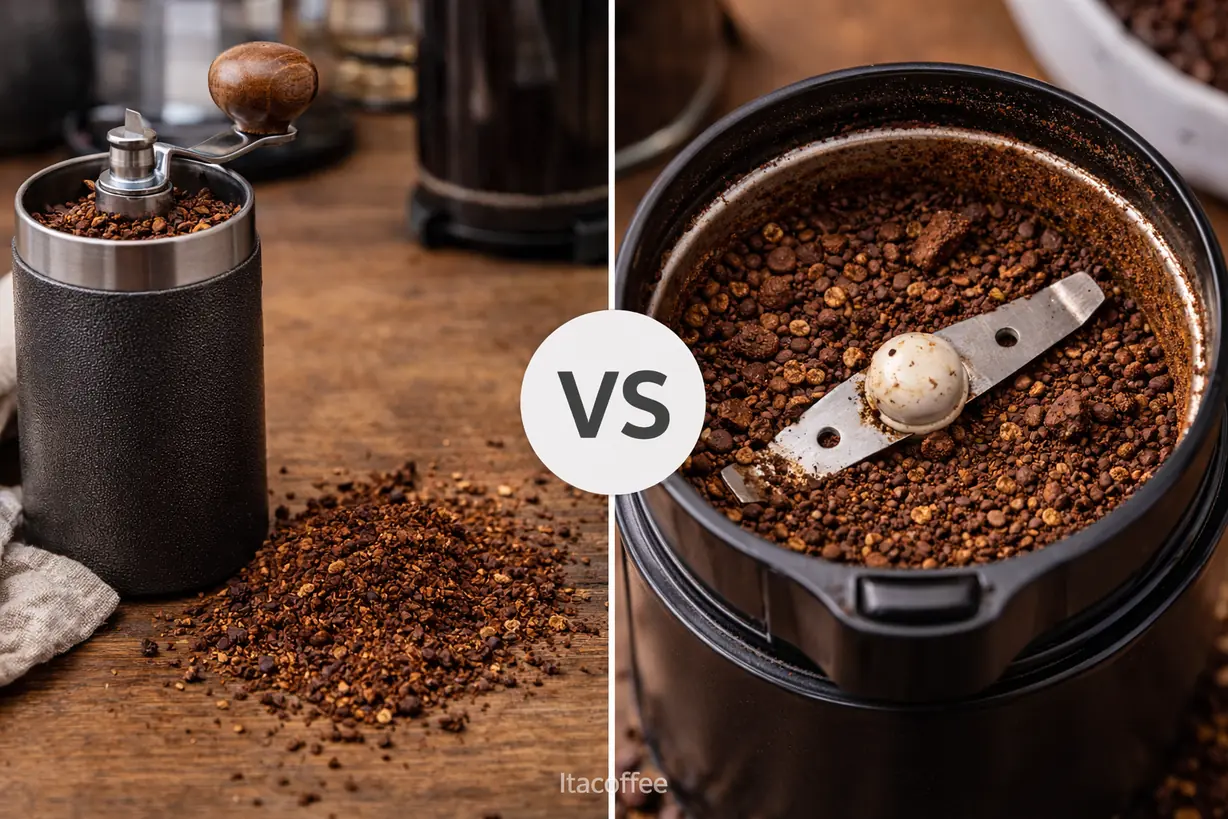
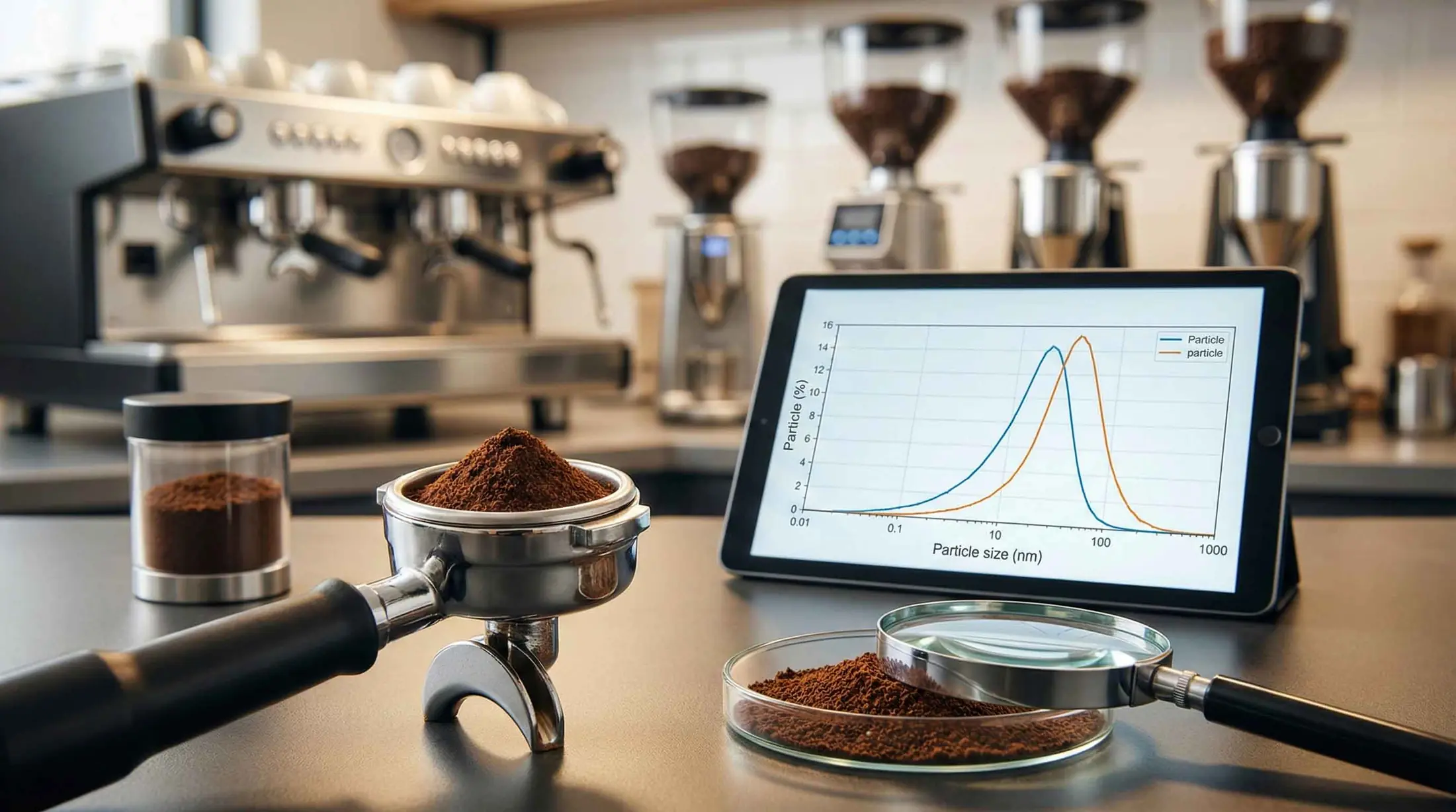
Commercial grinders utilize large, precisely aligned burrs and high-torque motors to create a narrow Particle Size Distribution (PSD). This means the vast majority of the coffee grounds are the exact same size. Consumer grinders inevitably produce a wider distribution, generating microscopic dust called “fines” and large chunks called “boulders.”
- Fines and Over-Extraction: Because fines have immense surface area relative to their mass, water extracts their soluble compounds instantly, rapidly leading to bitter, astringent flavors.
- Boulders and Under-Extraction: Conversely, water struggles to penetrate the dense core of boulders, leaving behind desirable sugars and organic acids, resulting in sour, hollow flavors.
A commercial grinder’s ability to minimize fines and boulders ensures that water extracts flavor from every particle at the exact same rate. To understand the mechanics of how water interacts with these particles, review our guide on the physics of coffee grind size and extraction.
![[A line graph comparing the narrow, concentrated particle size distribution curve of a commercial flat burr grinder against the wide, flattened bimodal curve of a standard home burr grinder]](https://www.itacoffee.com/wp-content/uploads/2026/02/image_placeholder_compressed.webp)
Thermal Mass and Temperature Stability
Coffee is a complex matrix of over 1,000 chemical compounds, each possessing different solubility rates at different temperatures. Fruity organic acids dissolve readily at lower temperatures, while heavier, bitter compounds (like certain alkaloids and dry distillation products) require higher thermal energy to break down.
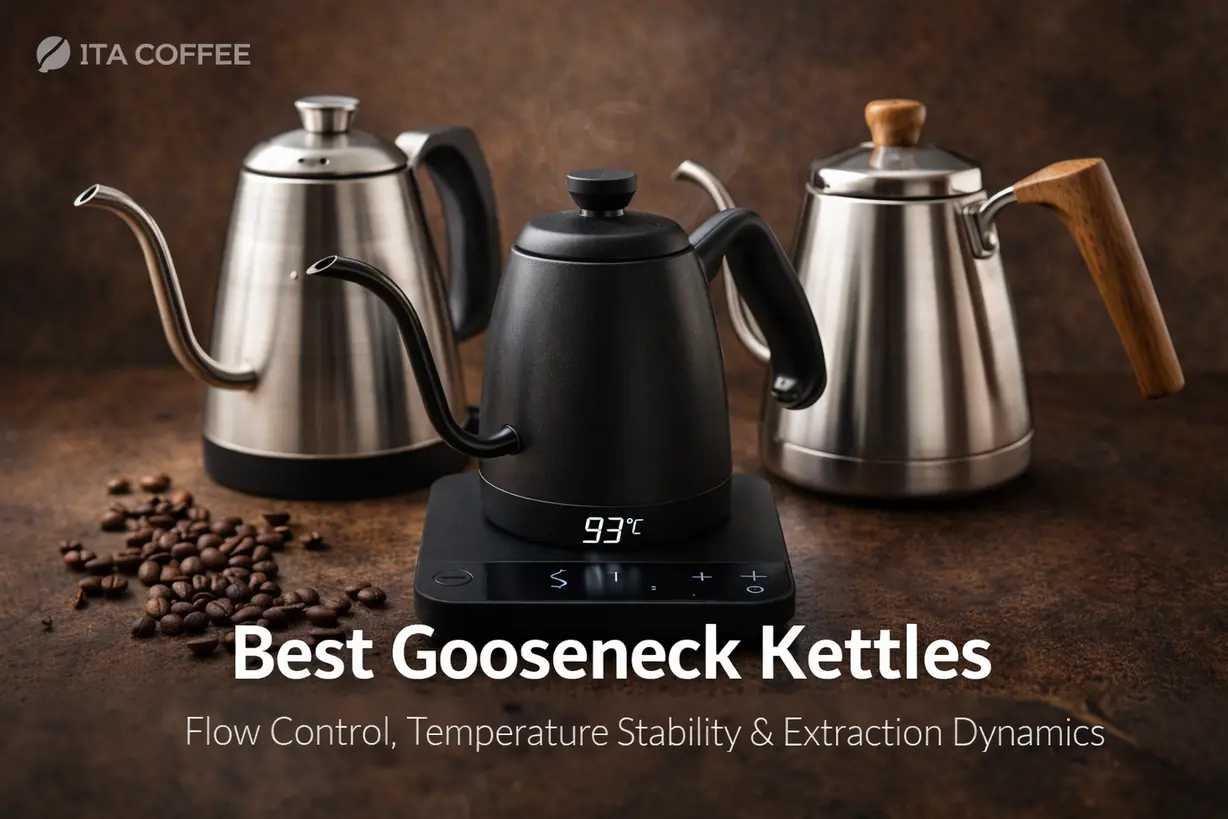
Café machines are built with massive brass or stainless steel boilers, saturated group heads, and PID (Proportional-Integral-Derivative) controllers. This creates immense thermal mass. When brewing water contacts room-temperature coffee grounds, a commercial machine maintains a stable temperature (e.g., exactly 93.0°C) throughout the entire extraction cycle.
In contrast, home kettles and entry-level espresso machines suffer from drastic temperature decay. A kettle might read 94°C off the boil, but by the time the water hits the slurry and completes a three-minute pour-over, the temperature may have plummeted to 85°C. This unpredictable thermal decay halts the extraction of heavier, sweeter compounds, throwing the cup out of balance. For a deeper understanding of this variable, explore our science-backed rules for water temperature.
Water Chemistry: The 98% Rule
Filter coffee is approximately 98.5% water; espresso is about 90% water. The mineral composition of this solvent dictates its extraction capacity.
Cafés do not use tap water. They employ reverse osmosis (RO) systems blended with specific remineralization valves to achieve a precise balance of calcium, magnesium, and bicarbonate alkalinity.
- Magnesium and Calcium: Act as chemical magnets, binding to flavor compounds in the coffee matrix and pulling them into the beverage.
- Alkalinity (Buffer): Neutralizes the perceived acidity of the coffee. Too much buffer makes coffee taste flat and chalky; too little makes it aggressively sour.
If your home water contains excessive scale-forming minerals or lacks the proper buffering capacity, even the best beans and grinders will yield a subpar beverage. Diagnosing under vs over extraction becomes impossible if the solvent itself is flawed.
Dialing In: The Scientific Method in Practice
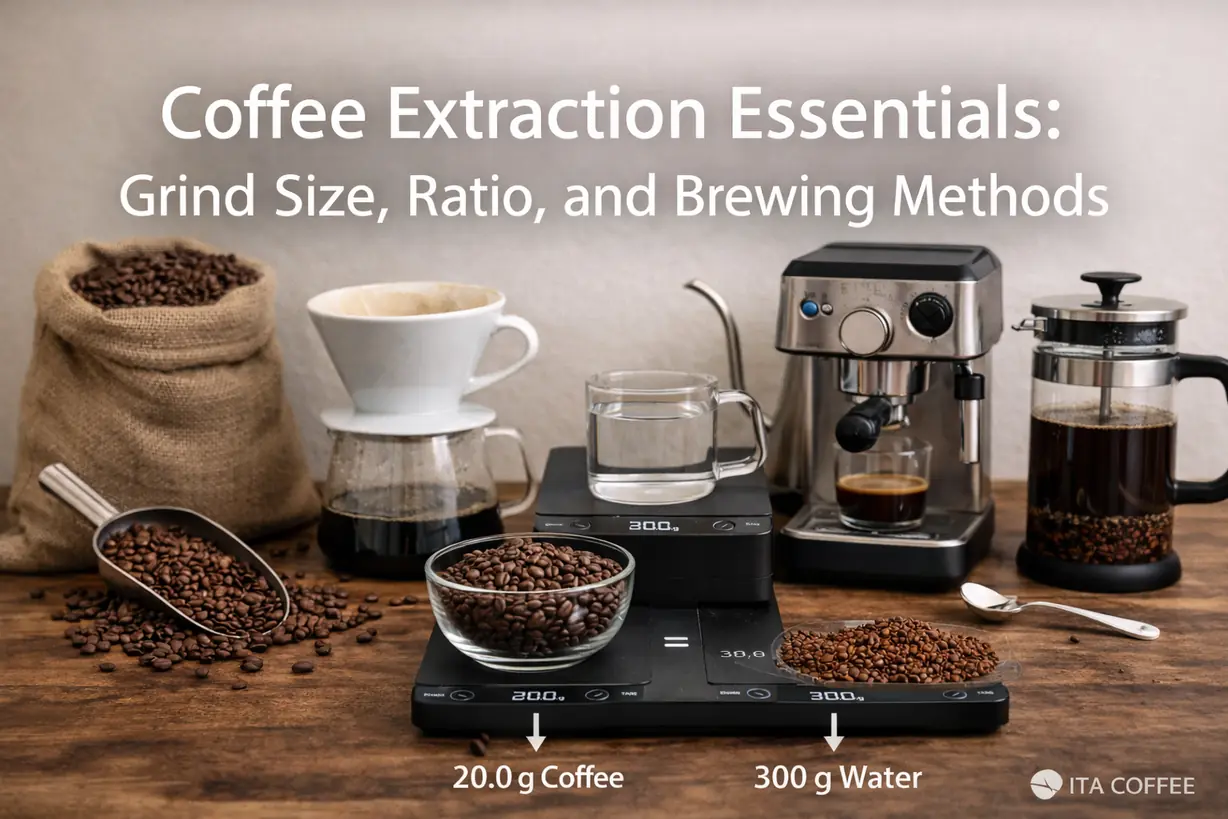
A commercial environment relies on rigid, daily parameter calibration known as “dialing in.” Baristas do not guess; they use high-precision scales to lock in exact coffee brew ratios.
By strictly controlling the dose (input mass) and the yield (beverage mass), the barista isolates the variables. If a shot runs too fast, they know with absolute certainty that the grind size or bean age is the culprit, not a fluctuating dose. At home, volumetric measuring (using scoops) obscures these variables, making it nearly impossible to replicate successes or systematically fix failures.
Comparing Environments: Commercial vs. Home
| Variable | Commercial Café Setup | Standard Home Setup |
|---|---|---|
| Particle Size | High uniformity; minimal fines/boulders resulting in even extraction. | Wide distribution; higher risk of localized over/under extraction. |
| Thermal Stability | Absolute. Temperature decay is measured in tenths of a degree. | Highly variable. Rapid heat loss through uninsulated kettles/brewers. |
| Water Chemistry | Engineered mineral content for optimal solvent efficiency. | Subject to local municipal tap water or generic bottled water. |
Conclusion
The superiority of café coffee is not an abstract concept; it is the physical manifestation of high-quality grinders, stable thermodynamics, and optimized water chemistry. While commercial equipment offers structural advantages, home brewers can drastically close the gap by adopting a scientific mindset.
Stop guessing your variables. Invest in a precise scale, utilize filtered water, and pre-heat your equipment to minimize thermal loss. By understanding the underlying physics, you can learn how to brew better coffee at home and maximize the potential of your current setup.
— ITA Coffee | Brewing Guides for Curious, Thoughtful Coffee Makers
Editorial note: This article was developed with AI-assisted drafting and human review to ensure clarity, accuracy, and an educational, non-commercial tone.