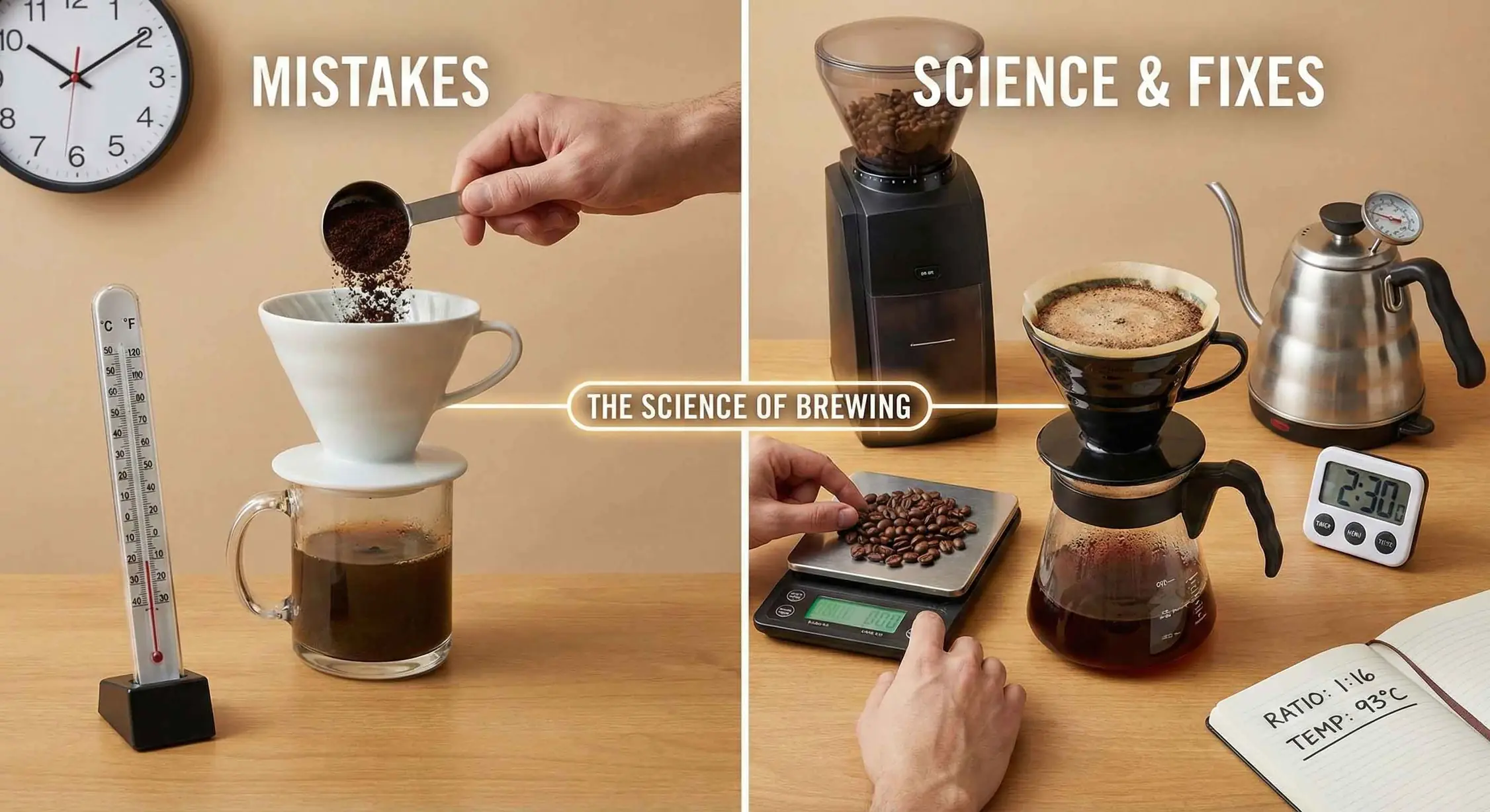
In the pursuit of laboratory-level precision in coffee brewing, the home environment presents a multitude of uncontrolled variables. When a cup of coffee presents as overwhelmingly bitter, sharply sour, or structurally hollow, it is rarely a subjective failure of taste; it is an objective failure of extraction. Most home brewers inadvertently sabotage their daily cup not through a lack of effort, but by ignoring the fundamental physics and chemistry that govern how water dissolves soluble compounds from roasted coffee seeds.
By analyzing the mechanics of brewing, we can categorize and correct the most common home brewing mistakes, shifting from a process of guesswork to one of calculated intention.
In This Guide
Mistake 1: Volumetric Measurement Over Mass
The most pervasive error in home brewing is the reliance on scoops or tablespoons to measure coffee. Coffee beans vary wildly in density depending on their origin, altitude, and roast degree. A dark roast bean is highly porous and takes up significantly more volume per gram than a dense, lightly roasted bean.
When you measure by volume, your coffee-to-water ratio fluctuates drastically from day to day. A scoop that holds 10 grams of a light roast might only hold 7 grams of a dark roast.
- The Consequence: Without a fixed mass, the solvent (water) to solute (coffee) ratio is randomized. This makes it impossible to systematically diagnose why your coffee tastes bitter or sour.
- The Solution: Gravimetric measurement is non-negotiable for repeatable results. Understanding the physics of precision brewing clarifies why you must ask yourself: do you really need a coffee scale? The scientific answer is unequivocally yes.
Mistake 2: Thermal Neglect and Temperature Decay
Coffee extraction is a thermodynamic process. The heat energy of the water dictates the kinetic energy of the molecules, which in turn determines which flavor compounds dissolve and at what rate.
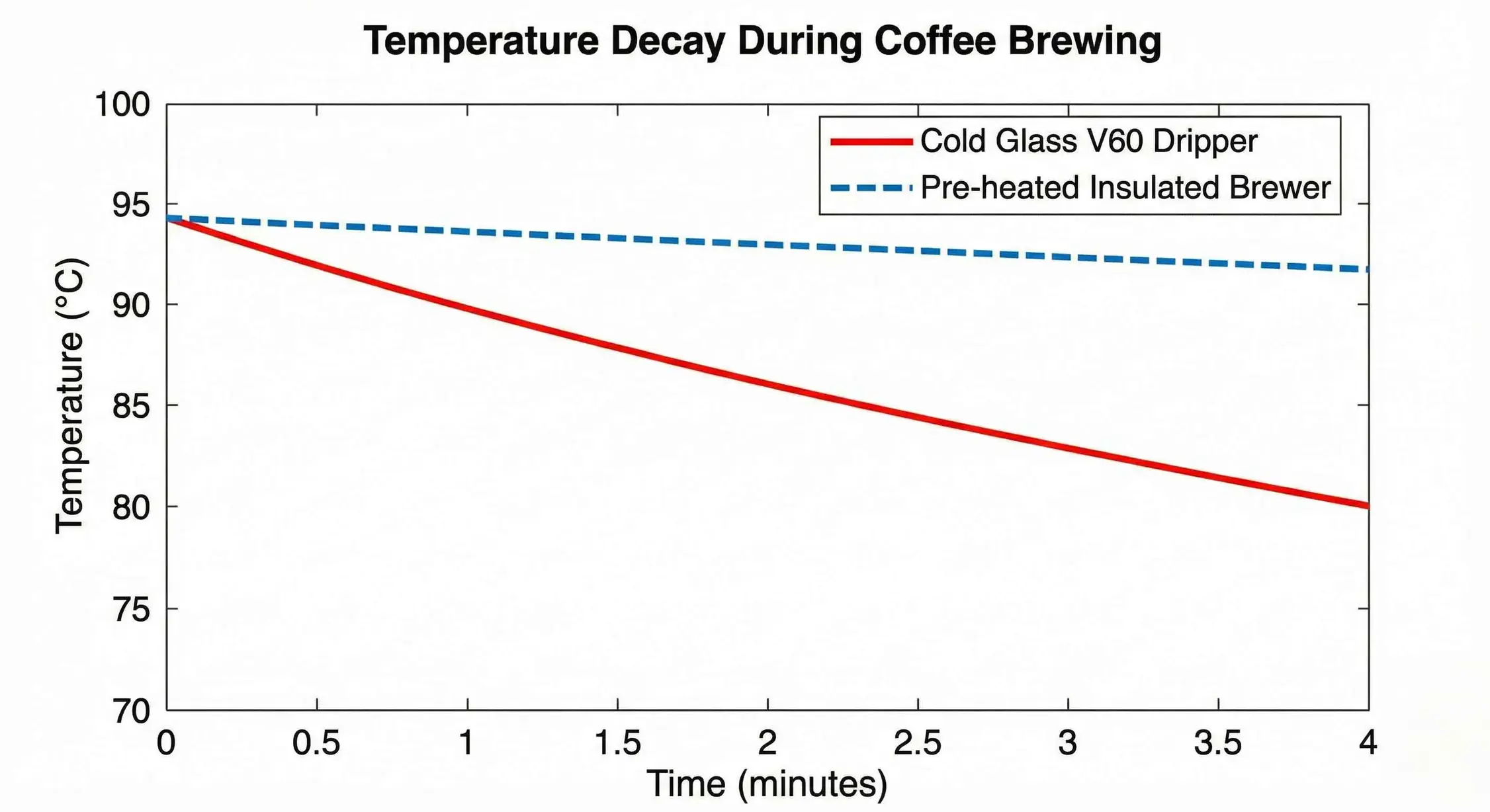
Home brewers frequently err by pouring water directly off the boil onto the coffee, or conversely, allowing the water to cool significantly in an uninsulated kettle before pouring. Furthermore, brewing into a cold ceramic or glass vessel immediately strips heat from the brewing slurry.
- High-Temperature Solubles: Bitter compounds and heavy structural carbohydrates require higher temperatures to extract. Uncontrolled high heat leads to over-extraction.
- Low-Temperature Solubles: Fruity organic acids dissolve readily at lower temperatures. If the slurry temperature drops too quickly (thermal decay), extraction halts prematurely, resulting in a thin, sour beverage.
Pre-heating your brewing vessel and utilizing a temperature-controlled kettle are critical structural steps. To master this variable, review our science-backed rules for water temperature.
Mistake 3: Grind Size Misalignment
Extraction is fundamentally a surface-area phenomenon. The purpose of grinding coffee is to expose the internal cellular structure of the bean to water. A common mistake is using a single, arbitrary grind size for entirely different brewing methods.
If you use a fine espresso grind in a French Press (an immersion method with a long contact time), the massive surface area combined with prolonged water exposure guarantees the extraction of harsh, astringent tannins. Conversely, using a coarse grind for a V60 pour-over (a percolation method with a short contact time) prevents the water from penetrating the coffee particles deeply enough, leaving the cup under-extracted.
You must intentionally match your particle size to your brew time. For a deeper dive into this mechanic, explore the physics of surface area and grind size.
Mistake 4: Brewing with Oxidized (Stale) Coffee
Coffee beans are essentially sealed vaults of volatile aromatic compounds and trapped carbon dioxide. The moment a bean is fractured in a grinder, its internal surface area is exposed to oxygen.
Buying pre-ground coffee is a chemical misstep. Within 15 minutes of grinding, coffee loses over 60% of its volatile aromatics through oxidation. Furthermore, the rapid degassing of CO2 means the coffee will no longer “bloom” when exposed to hot water. The bloom is not merely visual; the escaping CO2 creates turbulence that aids in even saturation. Without it, water channels through the grounds unevenly. Understanding the chemistry of staling and extraction is paramount to retaining cup quality.
Categorizing the Errors: Mechanics vs. Chemistry
| Common Mistake | Scientific Consequence | Corrective Action |
|---|---|---|
| Volumetric Measuring | Inconsistent solvent-to-solute mass ratio. | Utilize a digital scale reading to 0.1g. |
| Thermal Neglect | Premature halting of extraction due to heat loss. | Pre-heat all brewing vessels; monitor kettle temperature. |
| Incorrect Grind Size | Mismatched surface area relative to water contact time. | Calibrate particle size based on percolation vs. immersion physics. |
| Using Pre-Ground Beans | Severe oxidation of volatile aromatic compounds. | Grind immediately before water contact. |
Conclusion
A poorly extracted cup of coffee is not a mystery; it is data. When you recognize that bitter flavors stem from over-extraction and sour flavors from under-extraction, you can manipulate your mechanical and thermal variables to correct the physical process.
Cease measuring by volume, respect the thermodynamics of your equipment, and align your grind size with your chosen method. By establishing these scientific baselines in your kitchen, you remove the element of chance from your morning routine.
— ITA Coffee | Brewing Guides for Curious, Thoughtful Coffee Makers
Editorial note: This article was developed with AI-assisted drafting and human review to ensure clarity, accuracy, and an educational, non-commercial tone.