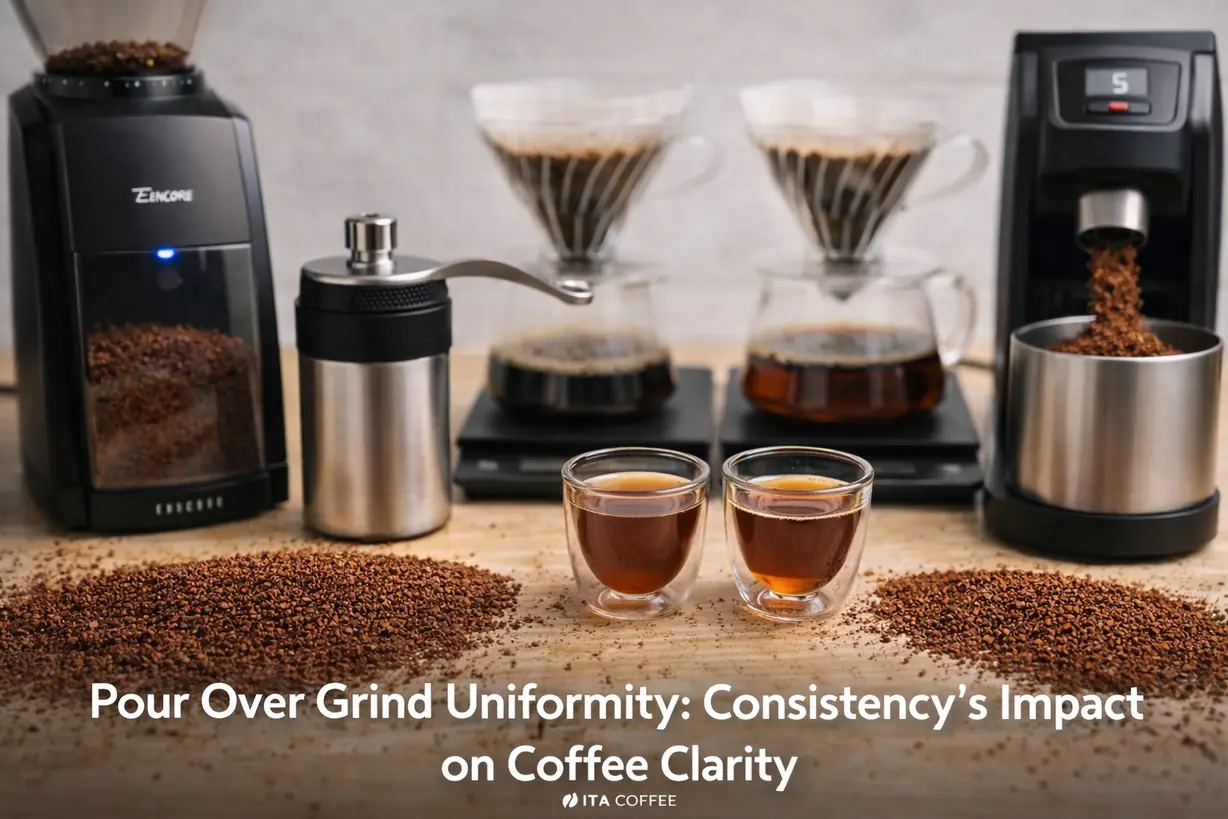
A structured analysis of grind consistency, particle distribution, and extraction control for pour over brewing
In This Guide
Introduction: Why Grinder Choice Defines Pour Over Quality
Pour over coffee is a percolation brewing method, meaning water flows through a bed of coffee grounds and extracts soluble compounds progressively.
This makes grind consistency far more critical than many brewers initially assume.
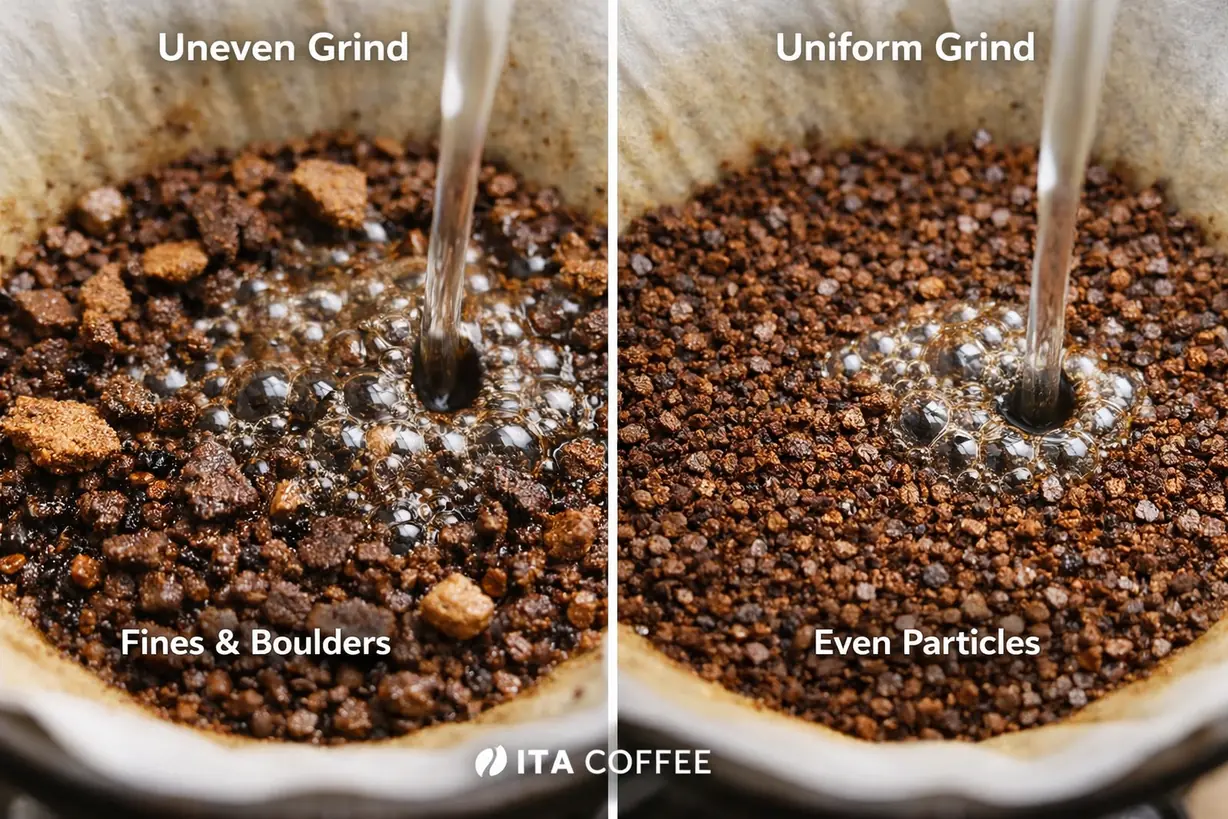
If the grinder produces uneven particles:
- Fine particles (fines) over-extract → bitterness
- Large particles (boulders) under-extract → sourness
This imbalance is explained in detail in Coffee Extraction Explained.
In pour over, where flow rate and contact time are tightly linked, particle uniformity directly determines flavor clarity.
What Defines a Good Pour Over Grinder
1. Particle Size Distribution (Core Variable)
A grinder is not judged by “grind size,” but by distribution spread.
A narrow distribution:
- Produces even extraction
- Stabilizes flow rate
- Improves repeatability
This principle is explored further in Coffee Grind Size Extraction Explained.
2. Burr Type: Conical vs Flat
Most pour over grinders use:
- Conical burrs → slightly wider distribution, more forgiving
- Flat burrs → tighter distribution, higher clarity but less forgiving
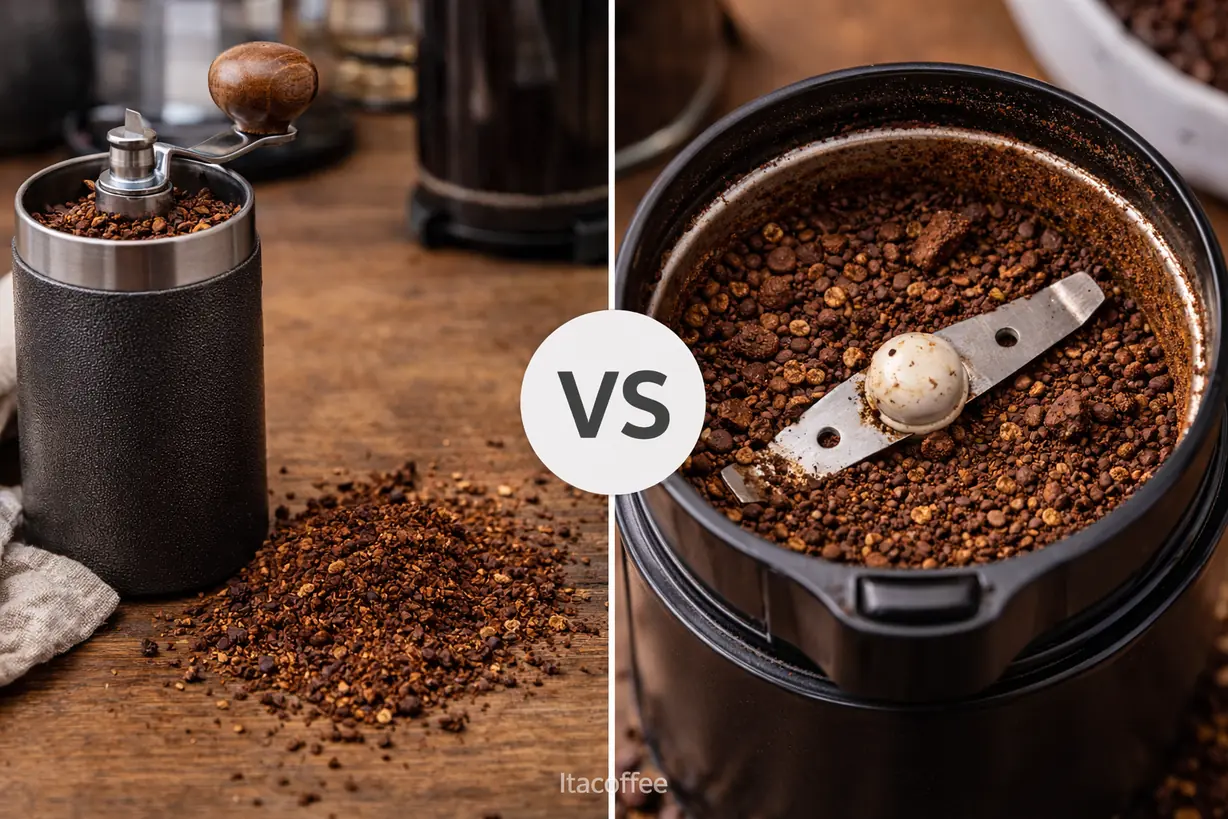
For a technical breakdown, see Burr vs Blade Coffee Grinders.
3. Grind Adjustment Precision
Pour over sits in the medium to medium-coarse range, but small adjustments matter.
A good grinder should:
- Allow repeatable adjustments
- Maintain burr alignment across settings
4. Workflow Stability
Consistency is not only mechanical:
- Retention (coffee left inside grinder)
- Static (affecting dose accuracy)
- Ease of adjustment
These influence real-world brewing consistency more than raw specifications.
Best Grinders for Pour Over (Categorized by Use Case)
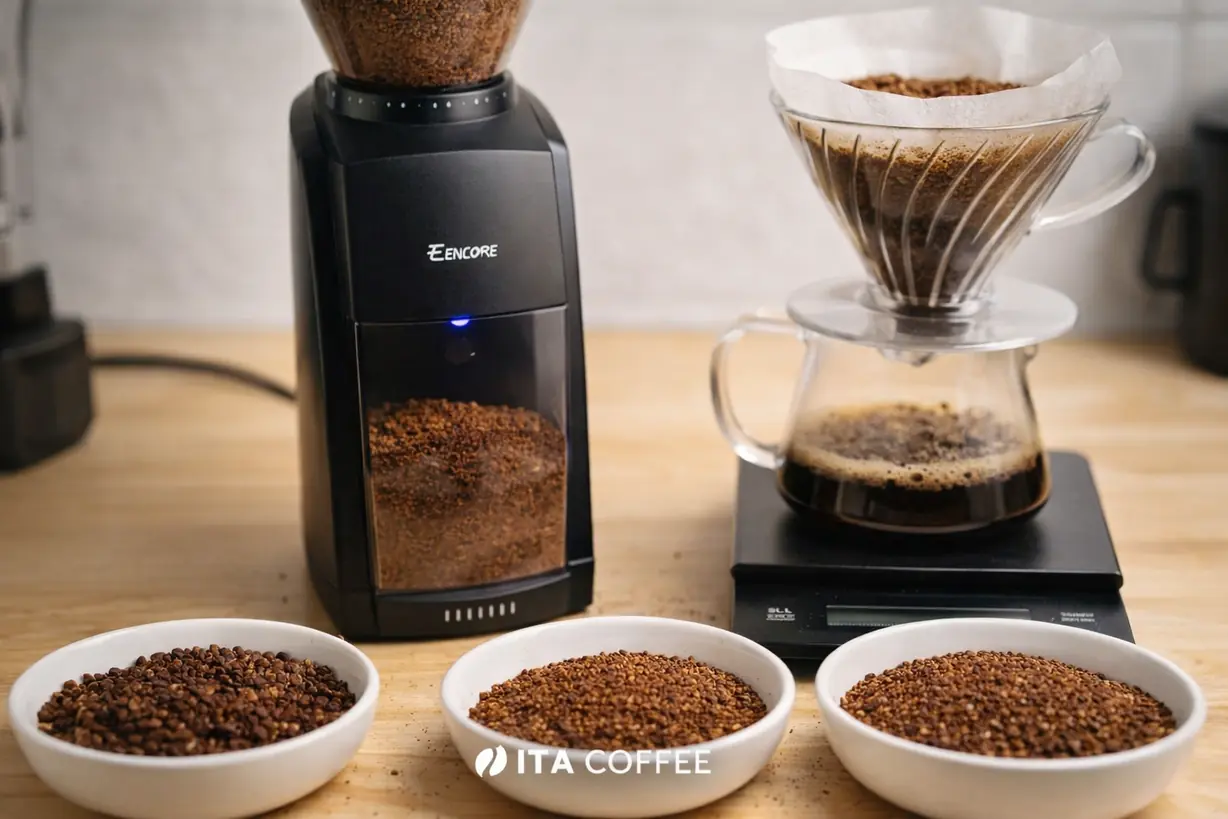
1. Entry-Level Electric: Baratza Encore
Core Characteristics:
- 40 mm conical burrs
- Stepped grind adjustment
- Designed for medium to coarse ranges
Performance Analysis:
- Significant improvement over blade grinders
- Acceptable distribution for pour over
- Some fines still present, but manageable
Detailed evaluation: Baratza Encore Conical Burr Grinder Review
Limitations:
- Limited precision for fine adjustments
- Retention and static variability
Conclusion: A baseline reference grinder for consistent pour over.
2. High-Precision Manual Grinders
Core Characteristics:
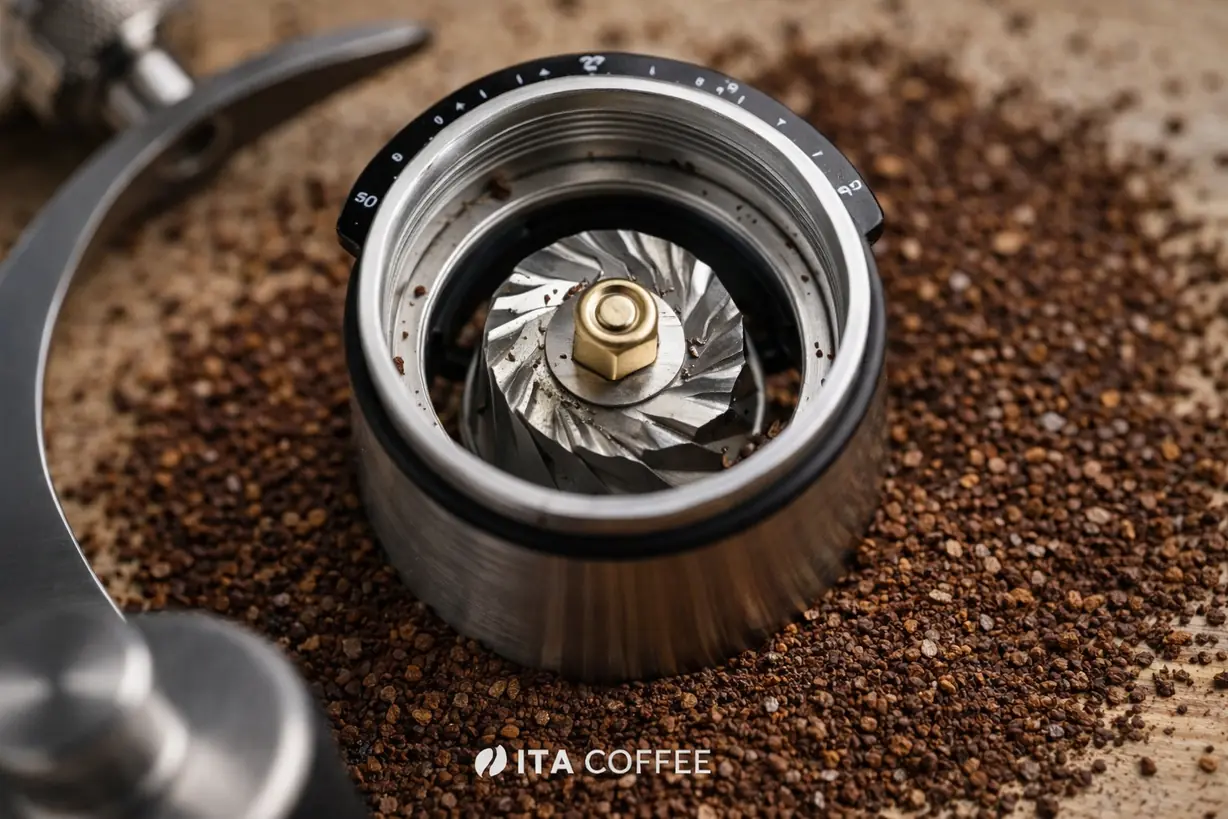
- High-quality steel burrs
- Low RPM grinding
- Minimal heat and static
Why They Excel:
- Very narrow particle distribution
- Reduced fines compared to entry electric grinders
- Improved flavor clarity and separation
For a full breakdown: Best Manual Coffee Grinders
Trade-offs:
- Manual effort required
- Slower workflow
Conclusion: Often the highest grind quality per dollar for pour over.
3. Mid-Range Electric Grinders
Core Characteristics:
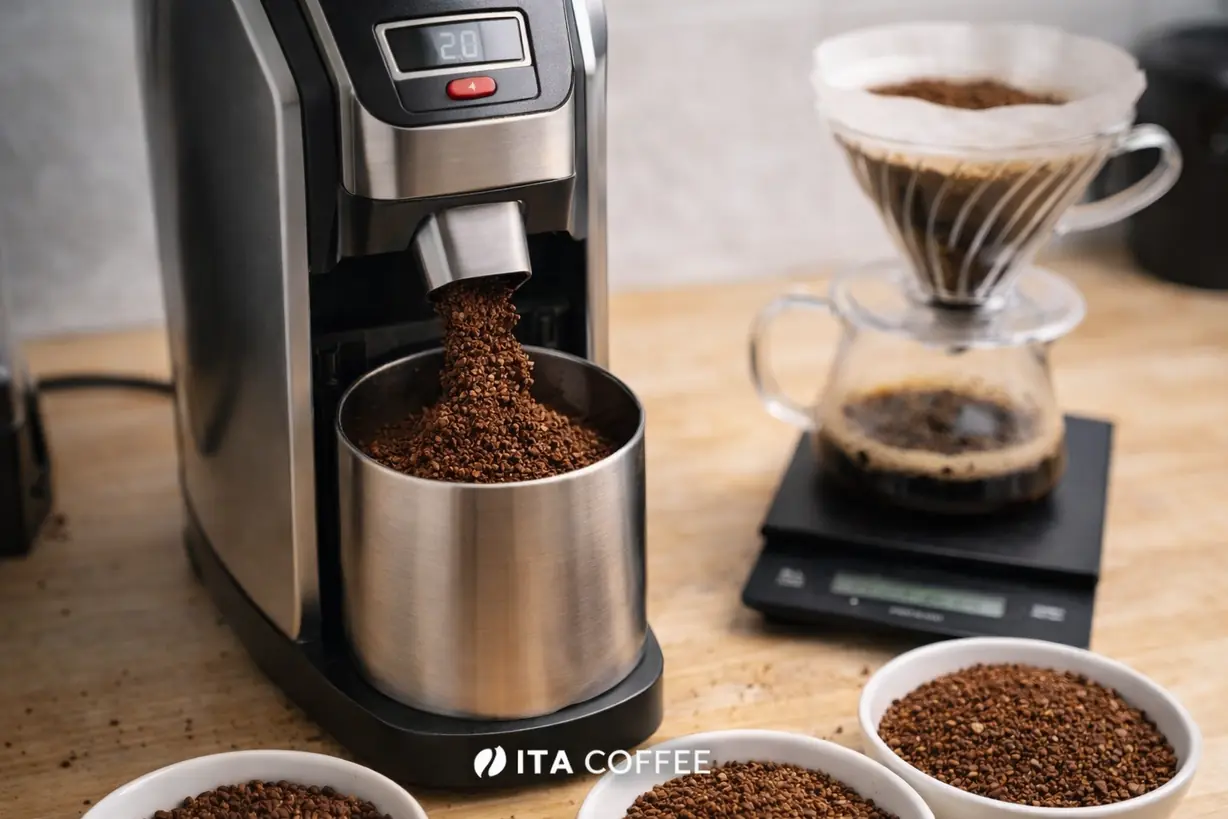
- Improved burr geometry
- Better alignment and motor stability
- Reduced fines production
Performance Impact:
- More stable flow rate in pour over
- Cleaner cup profile (less bitterness)
- Higher repeatability
These grinders bridge the gap between convenience and precision.
4. Flat Burr Grinders (Clarity-Focused Brewing)
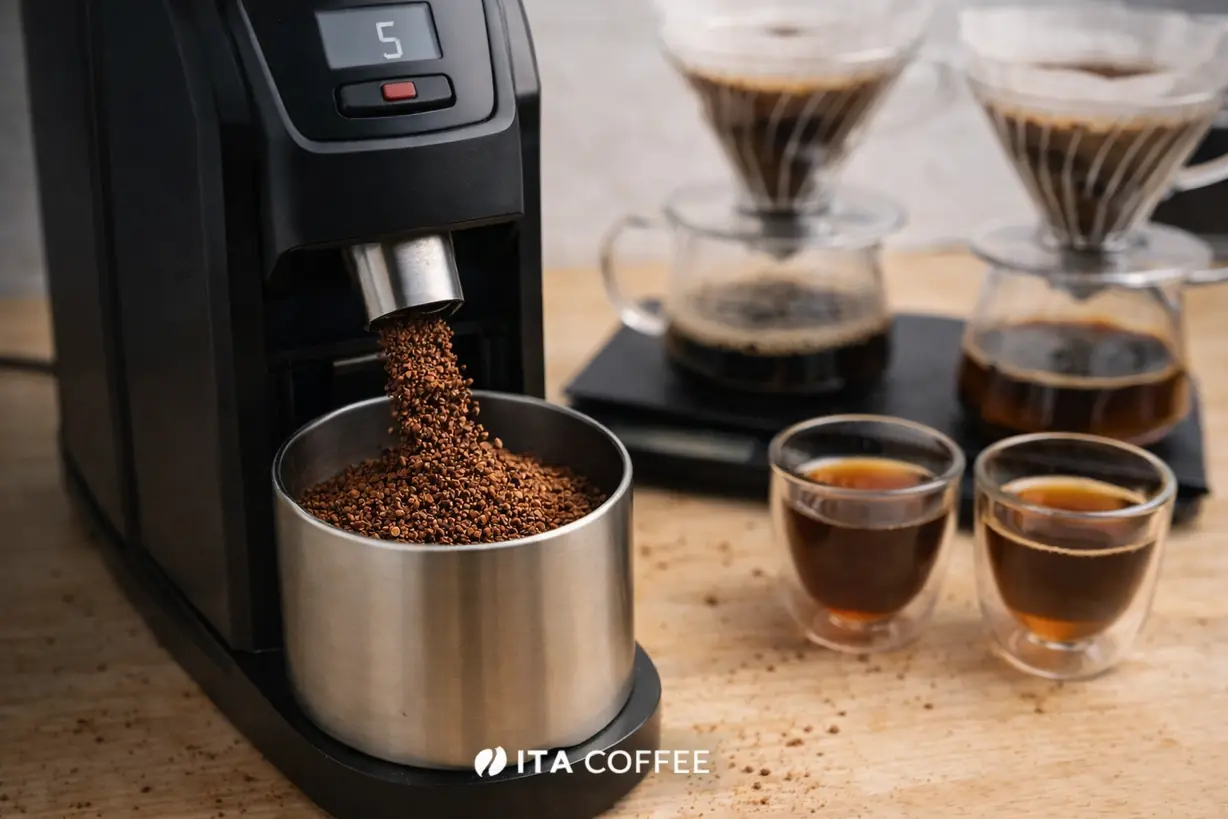
Core Characteristics:
- Narrow particle distribution (often unimodal)
- Higher clarity and separation of flavors
Extraction Behavior:
- Faster, more even extraction
- Less muddy overlap of flavors
Trade-offs:
- Less forgiving to grind size errors
- Higher cost
Conclusion: Best suited for advanced brewers optimizing flavor clarity.
How Grinder Quality Affects Pour Over Extraction
Flow Rate Stability
Uneven grind → inconsistent bed resistance → unstable flow.
This connects directly to:
Grind Size Time Ratio Relationship
Flavor Clarity vs Body
- More fines → heavier body, more bitterness
- Uniform particles → clearer acidity and structure
Under vs Over Extraction Balance
A mixed particle distribution causes simultaneous under- and over-extraction.
See: Under vs Over Extraction Explained
Common Mistakes When Choosing a Pour Over Grinder
- Focusing on grind settings count instead of distribution quality
- Assuming all burr grinders perform similarly
- Ignoring workflow variables (retention, static, consistency)
A broader framework is covered in:
How to Choose a Coffee Grinder
Manual vs Electric for Pour Over
- Manual grinders: better particle control, slower workflow
- Electric grinders: faster, more convenient, slightly wider distribution
Full comparison:
Manual vs Electric Coffee Grinder
Conclusion depends on:
- Brewing frequency
- Tolerance for effort
- Desired clarity vs convenience
Testing Methodology: How These Grinders Are Evaluated
Our evaluation aligns with:
How We Review Coffee Gear
Key criteria:
- Particle distribution (sieve + visual analysis)
- Extraction consistency across brews
- Workflow repeatability
This ensures conclusions are based on measurable extraction outcomes, not subjective impressions.
Final Conclusion: What Actually Matters Most
The best grinder for pour over is not defined by price or brand, but by one core principle:
How evenly it controls extraction through particle distribution.
In practical terms:
- Entry-level burr grinders → acceptable baseline
- Manual grinders → highest value precision
- Flat burr grinders → maximum clarity potential
However, technique still matters.
Even the best grinder cannot compensate for poor brewing variables:
How to Brew Better Coffee at Home
Explore More on ITA Coffee
At Itacoffee, the goal is not to recommend tools, but to help you understand how each variable shapes extraction—so your brewing decisions become predictable and repeatable.
This article was written and structured based on ITA Coffee’s evaluation framework and internal knowledge system.